
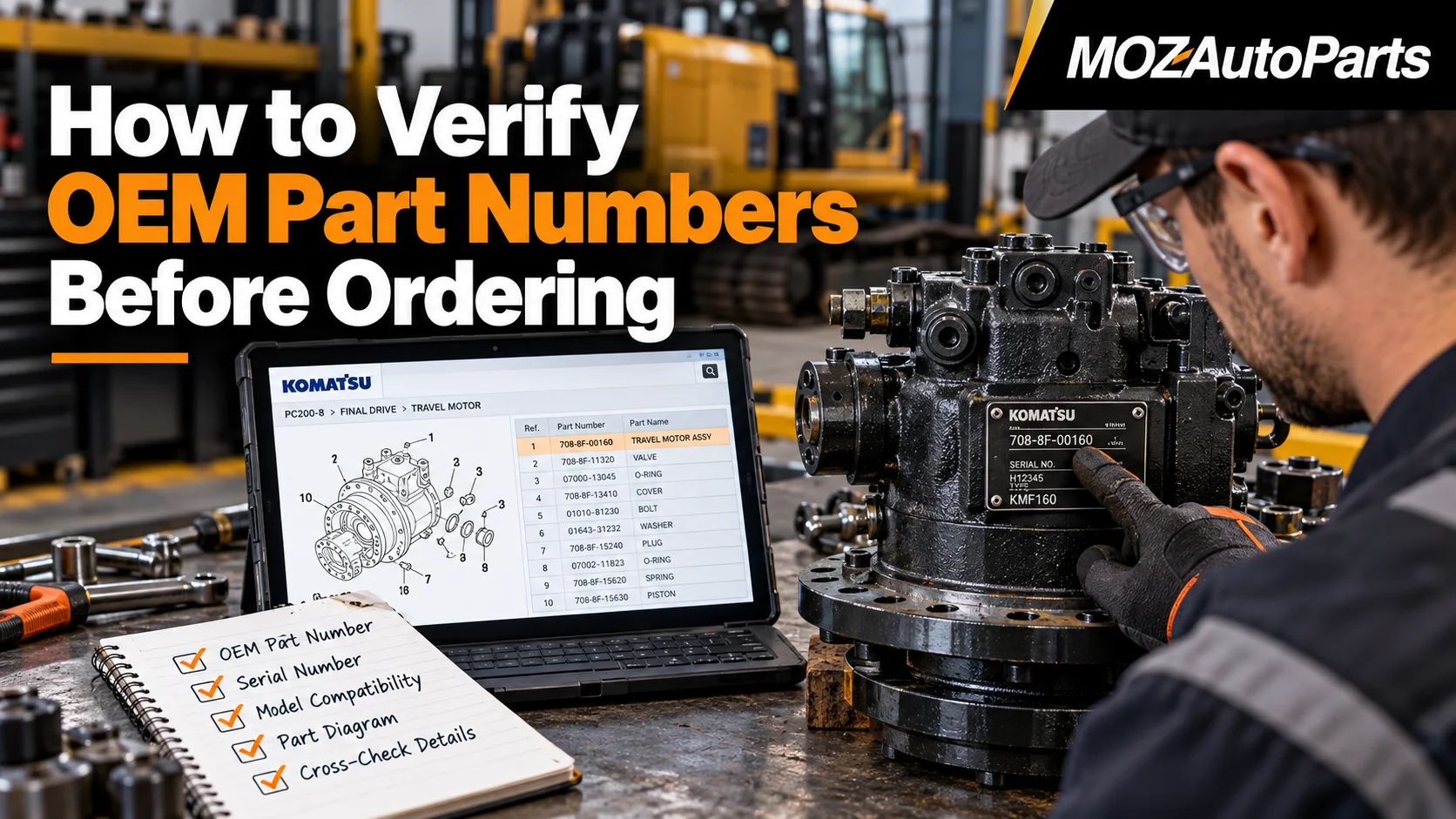
Quick answer: Verify the complete number on the component, identify the exact machine and engine by serial number, and confirm the current service number in the OEM parts catalog. Then check serial breaks, supersession notes, and the replacement specifications before ordering.
A number on an old component may be incomplete, superseded, tied to a serial range, or not orderable at all. Two machines with the same model name can use different parts because of production changes, engine configuration, or engineering revisions.
Use this guide to connect the number to the actual equipment before purchasing a replacement.
Why OEM Part Number Verification Matters
A wrong part can mean return freight, repeated labor, installation damage, and equipment downtime. International shipping and emergency sourcing can cost more than the original order.
The risk rises with hydraulic pumps, final drives, turbochargers, injectors, and controllers. The goal is to establish a reliable chain between the machine, installed component, OEM catalog, and proposed replacement.
What Is an OEM Part Number?
An OEM part number identifies a component, assembly, repair kit, or service part in an original equipment manufacturer's parts system.
One starter can carry the machine manufacturer's service number, the component supplier's number, a serial number, and a revision code. These identify different things; record the labels and their context before deciding which number to order.
OEM vs OE vs Manufacturer vs Aftermarket Part Numbers
- OEM part number: the equipment manufacturer's service reference.
- Component manufacturer number: the supplier's identifier, which may differ from the equipment OEM number.
- Aftermarket part number: the replacement manufacturer's reference for its product.
- Cross reference: a proposed link between numbers from different systems.
OE describes original-equipment supply. An OEM reference in a listing does not prove the supplied product is genuine OEM. Confirm its actual brand, condition, and specifications.
Similar supplier numbers can represent different configurations. Cross references help locate candidates; dimensions, ratings, mounting, connectors, and application still need verification.
Where Can You Find an OEM Part Number?
Start with the old component. Inspect printed labels, metal identification plates, laser-etched or stamped markings, barcode labels, and original packaging. A small side label may contain the service number while a prominent raised number identifies only a housing.
Take sharp photographs before cleaning aggressively, rebuilding, or discarding the component. Preserve all letters, prefixes, suffixes, and revision marks.
Part Number vs Serial Number vs Casting Number
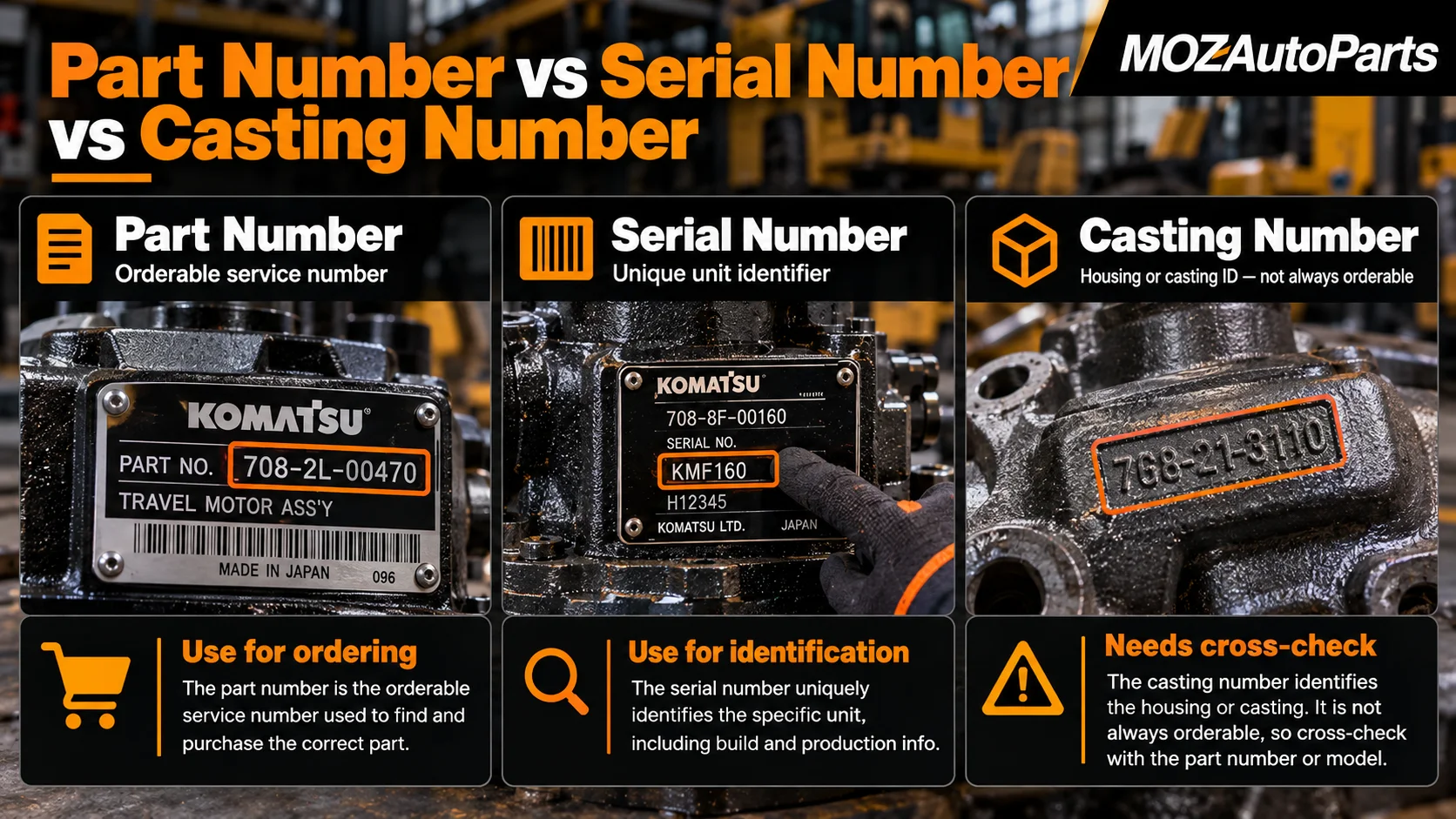
One of the most common sourcing mistakes is assuming that every number found on a component is an orderable part number.
It is not.
| Marking | Typical Meaning | Can You Order With It? |
|---|---|---|
| P/N or Part No. | Service or manufacturer part number | Usually |
| S/N or Serial No. | Unique identifier for one unit | Usually not |
| Model | Product family or component model | Sometimes insufficient |
| MFG No. | Manufacturer reference | Sometimes |
| Casting No. | Number identifying a casting | Usually not |
| Assembly No. | Assembly identifier | Depends on manufacturer |
| REV / Revision | Engineering revision | Important for verification |
| Date Code | Manufacturing date/batch | Usually not |
| Machine PIN/SN | Equipment identification number | Used to find parts |
| Engine Serial Number | Engine-specific identifier | Used to find engine parts |
Never Assume a Casting Number Is the Part Number
Casting numbers cause many incorrect inquiries.
A number molded or raised directly in a housing often identifies the casting from which the finished component was manufactured.
The same casting may be machined, assembled, calibrated, or configured into several different finished products.
This is common with:
- Pump housings
- Engine components
- Gearbox housings
- Valve bodies
- Starter housings
- Alternator housings
- Manifolds
- Cylinder components
If the only visible number appears to be a casting number, do not rely on it alone.
Instead, provide the machine information and detailed photos so the component can be identified through additional references.
About the illustrations: Labels, part numbers, serial ranges, and catalog screens in these graphics illustrate the workflow. They are not verified fitment records; use the actual machine plate and manufacturer catalog.
The 3-Level OEM Part Number Verification Method
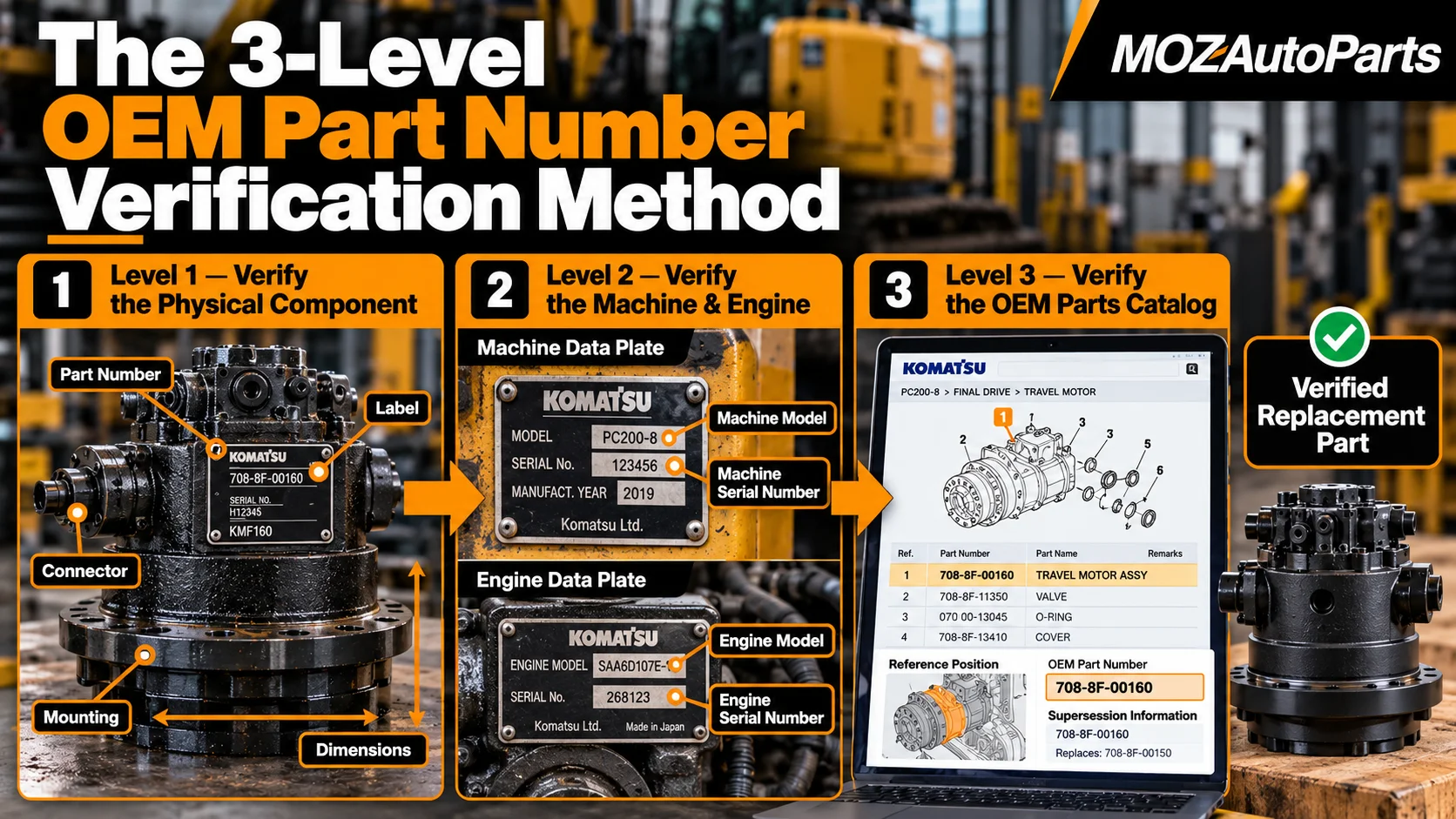
For important parts, we recommend verifying the number at three levels.
Level 1 - Verify the Physical Component
Record the complete part number, supplier name, component model, serial number, and revision. Capture readable labels plus the whole component from several angles; surrounding fittings can help identify a variant.
Compare mounting holes, flange, shaft diameter and spline, tooth count, pulley, connector, ports, and orientation. Check the applicable voltage, current, pressure, flow, and dimensions. Investigate any difference before ordering.
Level 2 - Verify the Machine and Engine
Record the equipment make, exact model, machine serial number or PIN, and production year if known. For engine parts, add engine make, model, serial number, and arrangement or CPL where applicable. Include the transmission model and serial number for transmission components.
A model name covers a product family, not necessarily one fixed build. Match the catalog to the serial range and the component actually installed.
Why the Machine Serial Number Matters
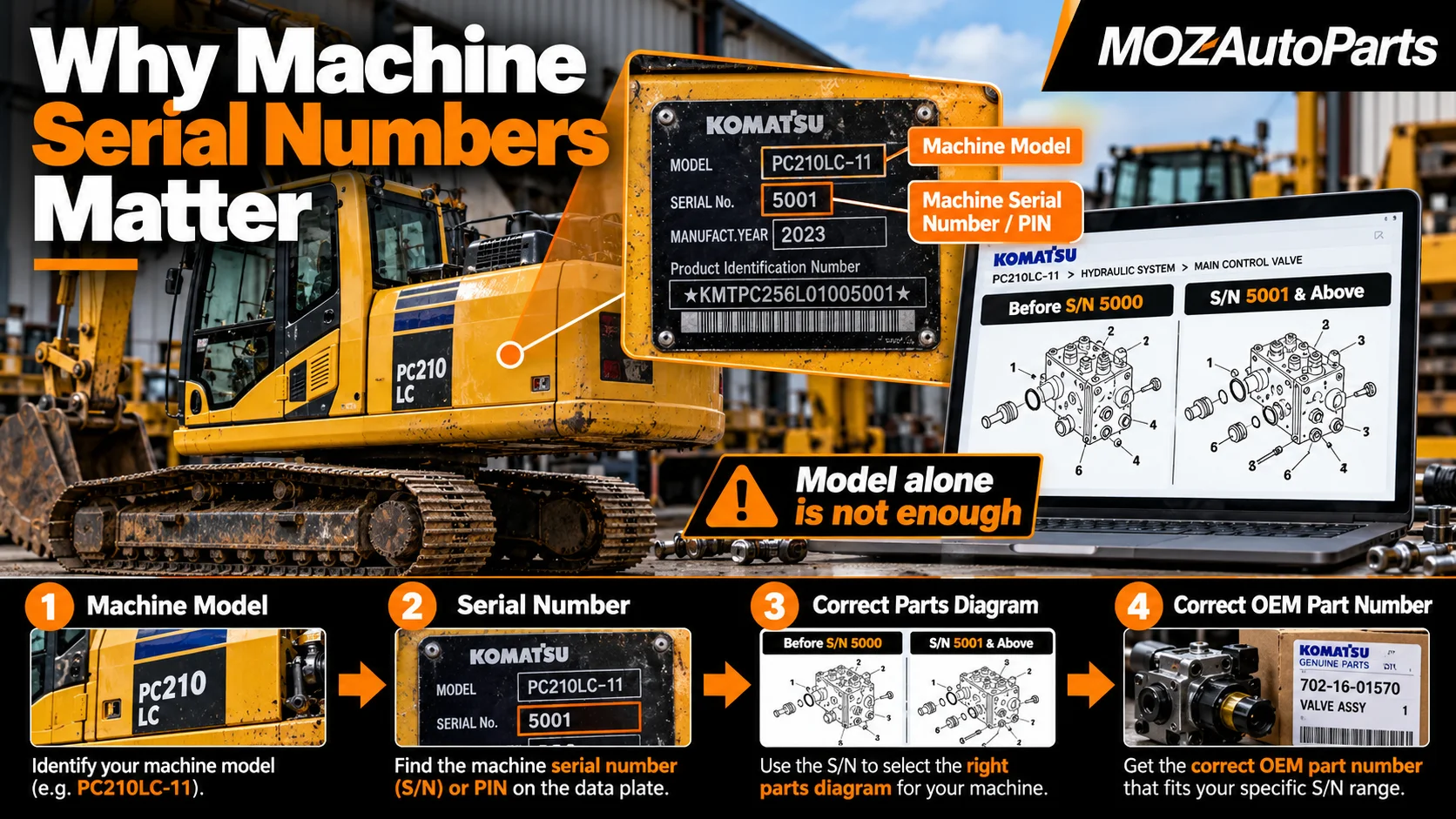
The machine model identifies the product family.
The serial number identifies a much more specific production configuration.
OEM parts catalogs commonly use serial-number-specific equipment information because the parts installed during different production periods can vary.
For example, parts documentation may specify:
Up to and including S/N 5000
and
S/N 5001 and Above
This is an illustrative serial number break, not a real model specification. Read the exact inclusive/exclusive limits in the catalog; do not infer which side of a boundary your machine belongs to.
Caterpillar’s official parts-diagram lookup asks for equipment and serial number to select relevant diagrams. A replaced engine or modified assembly may differ from the factory build, so compare the installed component too.
Serial breaks can affect hydraulics, engines, electrical systems, undercarriage, transmission, and cooling. The lookup path is manufacturer → model → serial number/PIN → production configuration → diagram → reference position → OEM part number.
Machine Serial Number vs Engine Serial Number
The machine serial number identifies the complete equipment; the engine serial number identifies the specific engine. They are separate identifiers and should not be substituted for one another.
For injectors, fuel pumps, turbos, water pumps, sensors, and overhaul parts, the engine manufacturer's records may be needed alongside the equipment catalog. A repowered machine especially requires checking the installed engine.
For Cummins engines, record the ESN, CPL, engine model, and rated horsepower/RPM when available. Cummins' engine identification guide explains ESN locations and the information on the ISX dataplate.
Level 3 - Verify the OEM Parts Catalog
After checking the physical component and machine information, verify the part in the appropriate OEM catalog or electronic parts catalog.
A proper catalog lookup usually involves:
- Select the machine manufacturer.
- Enter the exact model.
- Enter or verify the machine serial number.
- Open the correct system or component group.
- Find the component on the exploded parts diagram.
- Identify the reference position.
- Read the OEM part number.
- Check notes and serial-number restrictions.
- Check whether the number has been superseded.
The diagram callout (such as item 12) is a position reference, not the orderable part number. Read the corresponding table row, quantity, assembly notes, and kit contents.
Unsure about the number? Request a fitment check with the full part number, machine model, serial number, and a description of the component.
What Is Part Number Supersession?
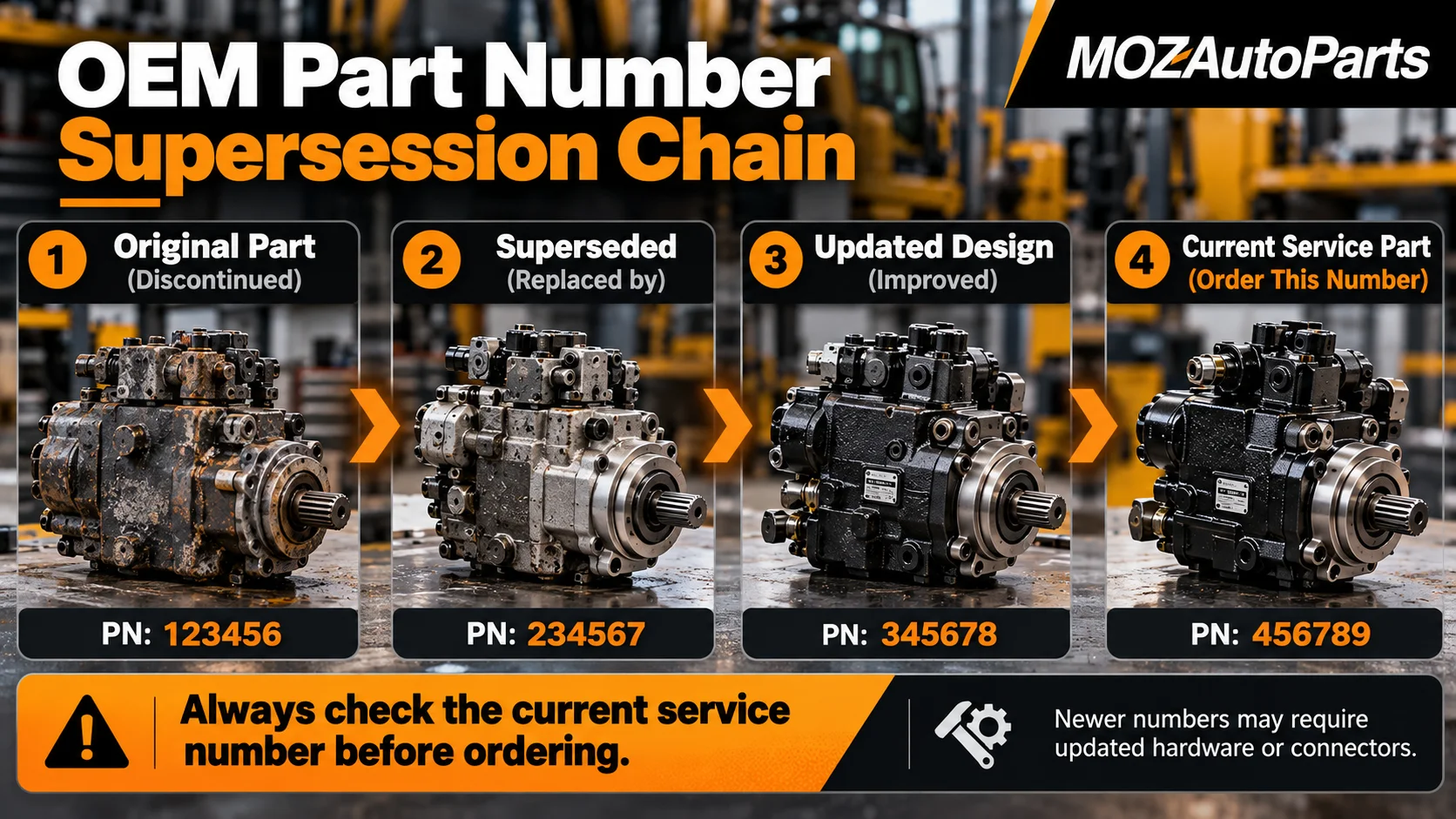
Supersession means a manufacturer has replaced an older service number with a newer one. Reasons include design, supplier, material, connector, or service-kit changes.
An illustrative chain is 123456 → 234567 → 345678 → 456789. These are example numbers, not a fitment reference. Follow the catalog to the current service solution rather than searching only for old stock.
Supersession Is Not Always Reversible
If Part B supersedes Part A, B is the intended replacement subject to the manufacturer's application notes. This does not establish that A can replace B on a later machine.
Check the Complete Service Solution
An updated part may require adapters, a harness, brackets, seals, hoses, hardware, calibration, or programming. Confirm these requirements and kit contents before ordering; a new number does not always mean a one-piece swap.
OEM Cross Reference vs Supersession
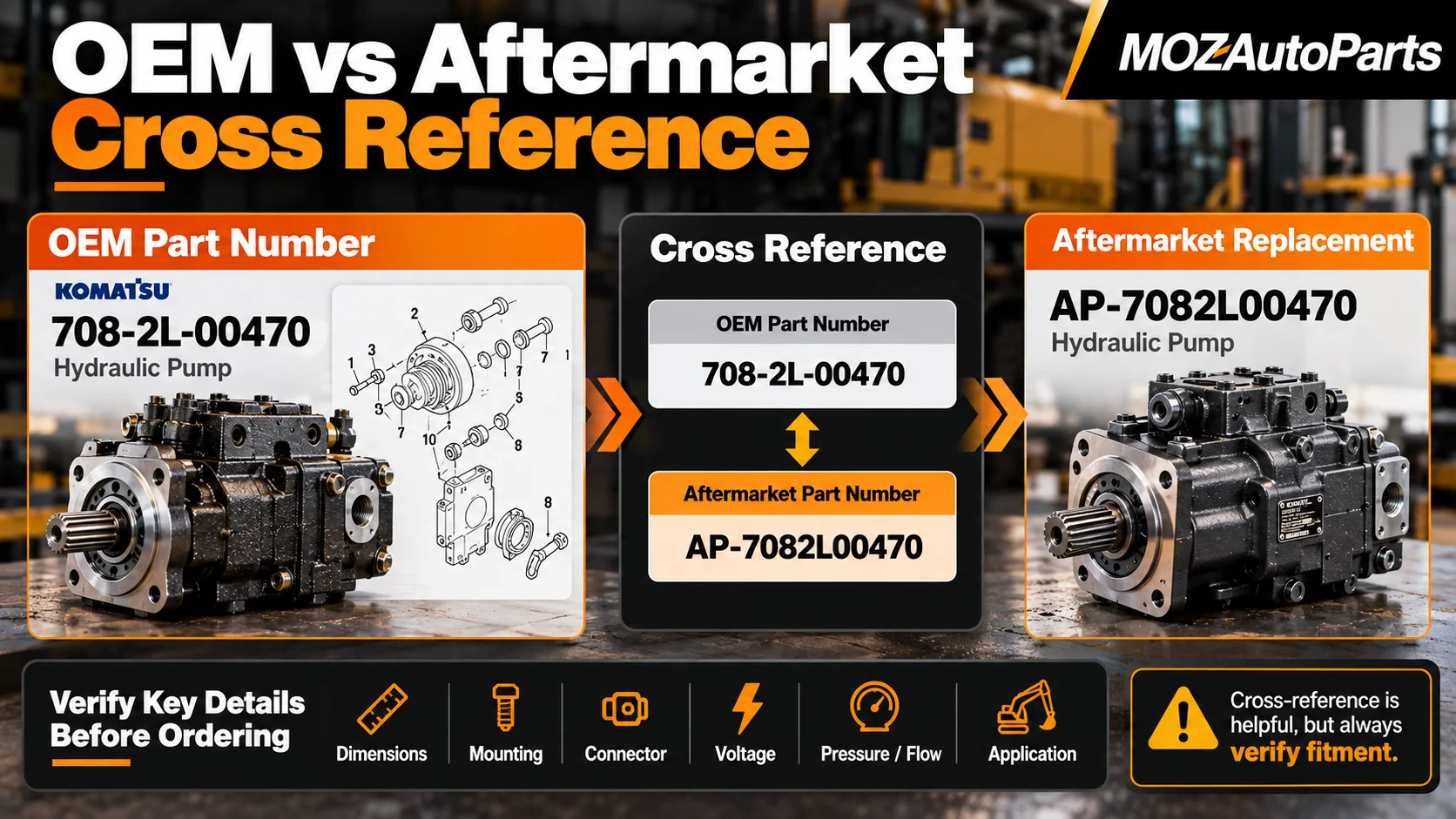
These two concepts should not be confused.
Supersession
A manufacturer replaces one service part number with another.
Example:
OEM PN A → OEM PN B
Cross Reference
Another manufacturer or database identifies a part as an alternative or equivalent.
Example:
OEM PN A → Aftermarket PN X
A cross-reference can be useful for sourcing alternatives, but it should still be verified.
When comparing a replacement, check:
- Dimensions
- Material
- Thread
- Voltage
- Amperage
- Connector
- Pressure
- Flow
- Shaft
- Spline
- Rotation
- Mounting
- Operating temperature
- Software compatibility
Do not use a cross-reference number as your only evidence for high-value or safety-critical components.
Never Ignore Part Number Suffixes
One character can matter.
For example:
123456-A
and
123456-B
may not be interchangeable.
Suffixes can indicate differences such as:
- Left vs right
- Front vs rear
- 12 V vs 24 V
- Connector type
- Output rating
- Port configuration
- Regional specification
- Emissions version
- Revision
- Material
- Calibration
Always record the complete part number, including:
- Hyphens
- Letters
- Spaces when meaningful
- Prefixes
- Suffixes
- Revision codes
Never shorten a number just because most of the digits are identical. If a search needs punctuation removed, retain the full original marking in your inquiry and verify the result against it.
Confirm Left, Right, Front, Rear, Upper, and Lower
Position matters for mirrors, lights, steering parts, cab panels, hydraulic assemblies, and track components. Record LH/RH, front/rear, upper/lower, inner/outer, or drive/driven as applicable.
Use the orientation convention in the manufacturer's manual. Include an installed-position photo if left/right could be ambiguous; a base part number alone may not resolve it.
How to Verify an Aftermarket Replacement
Aftermarket products can offer good availability and pricing, but the verification process should be more detailed.
Use the OEM number as the starting reference, then verify the physical and technical specifications.
| Verification Item | What to Compare |
|---|---|
| OEM reference | Exact original or superseded number |
| Dimensions | Length, width, diameter, thickness |
| Mounting | Hole pattern, flange, bracket |
| Electrical | Voltage, current, connector |
| Hydraulic | Pressure, flow, displacement |
| Mechanical | Shaft, spline, teeth, rotation |
| Material | Seal, housing, friction material |
| Configuration | Ports, sensors, accessories |
| Application | Machine model and serial range |
A visually similar part is not necessarily technically equivalent.
This becomes particularly important when buying components through general marketplaces or non-specialist sellers.
For related diagnosis, see how to test a starter solenoid. For equipment-specific context, read our John Deere 4430 parts lookup guide and excavator undercarriage inspection guide.
Parts That Require Extra Verification
Some components deserve additional checks because one incorrect specification can make the part unusable.
| Part Type | Key Information to Verify |
|---|---|
| Hydraulic pump | Model, displacement, shaft, port layout, rotation |
| Final drive | Machine serial number, motor number, gear ratio |
| Travel motor | Ports, displacement, brake configuration |
| Fuel injector | Engine serial number, injector code |
| Turbocharger | Engine model, engine arrangement, turbo PN |
| Starter motor | Voltage, power, teeth, flange, rotation |
| Alternator | Voltage, amperage, pulley, mounting |
| ECU / ECM | Hardware PN, software/calibration |
| Control valve | Port configuration, pressure, spool arrangement |
| Transmission | Model and transmission serial number |
| Seal kit | Exact cylinder, pump, valve, or motor model |
| Sensor | Connector, thread, range, electrical signal |
For these products, the equipment model alone should rarely be considered sufficient information.
What Photos Should You Send for Part Identification?
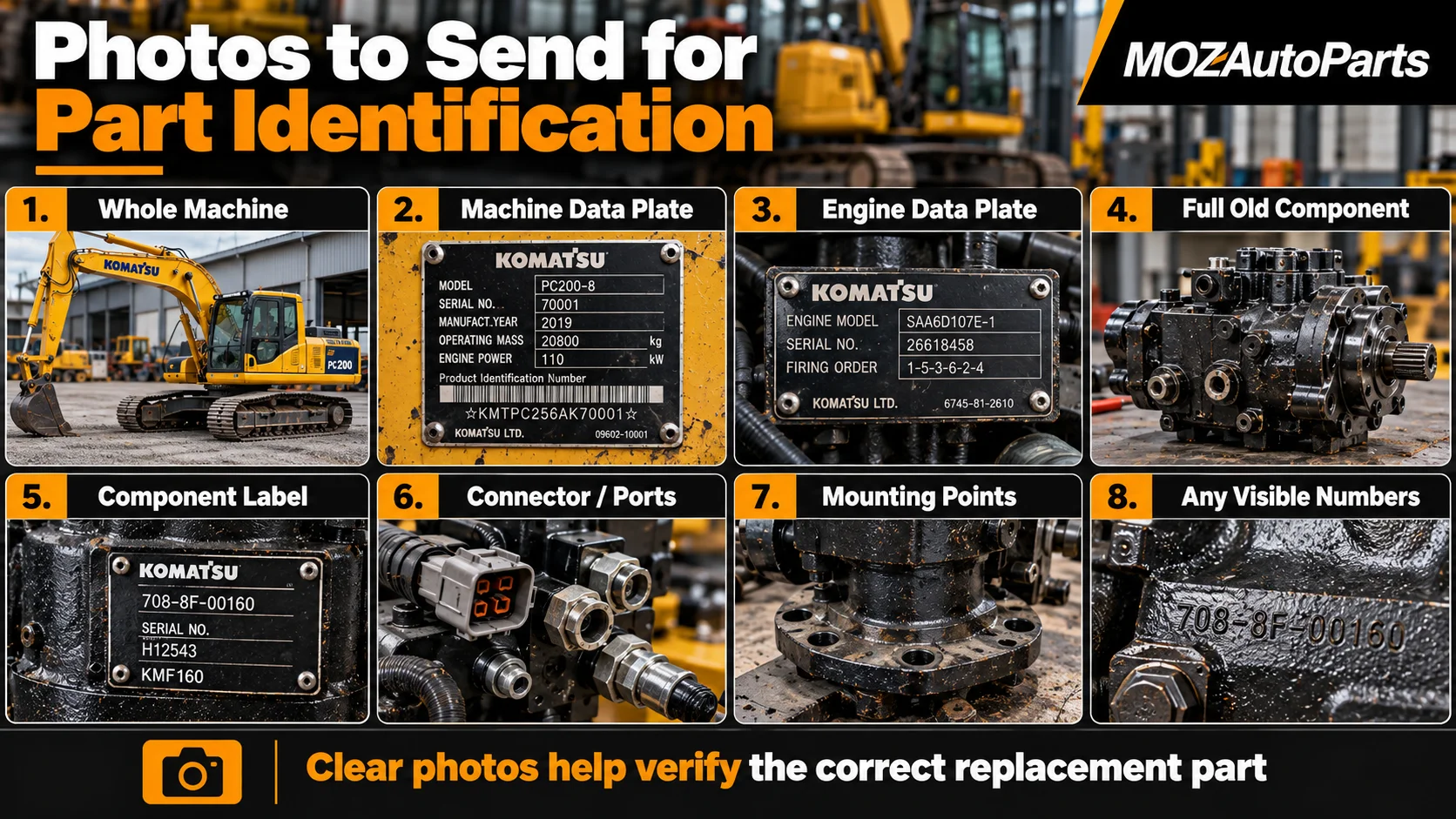
Provide clear, uncropped photos with readable labels:
- Whole machine: show the general application.
- Machine data plate: model and serial number/PIN.
- Engine data plate: essential for engine-related parts.
- Complete old component: several angles.
- Component label: every number and revision.
- Connector or ports: layout and connections.
- Mounting points: flanges, brackets, and holes.
- Other markings: stamped, engraved, or cast numbers.
Send both identification and configuration photos; one close-up of a number rarely provides the full context.
Have photos but no readable number? Contact us for part identification and send your machine details and identification photos by email.
Example: Same Excavator Model, Different Hydraulic Pump
In an illustrative excavator model, early and late production builds use different pumps. A model-only search returns both, so the model name cannot settle the order.
Match the machine serial number to the hydraulic-system diagram, read the pump's service number, check supersession, and compare the installed pump's label, shaft, ports, and mounting. Any conflict needs investigation before ordering.
10 Common OEM Part Number Verification Mistakes
- Ordering by model alone: check the exact serial range.
- Using a casting number as a service number: locate the orderable assembly.
- Ignoring engine identification: record the installed engine's serial number.
- Dropping a suffix: preserve the complete marking.
- Trusting a cross reference alone: compare technical specifications.
- Ignoring supersession: check the current service solution.
- Reversing a supersession: confirm the replacement direction.
- Matching photographs only: appearance cannot establish ratings or calibration.
- Sending one isolated number: include machine and component context.
- Ordering with unresolved conflicts: obtain fitment confirmation first.
5-Minute Pre-Order OEM Part Number Checklist
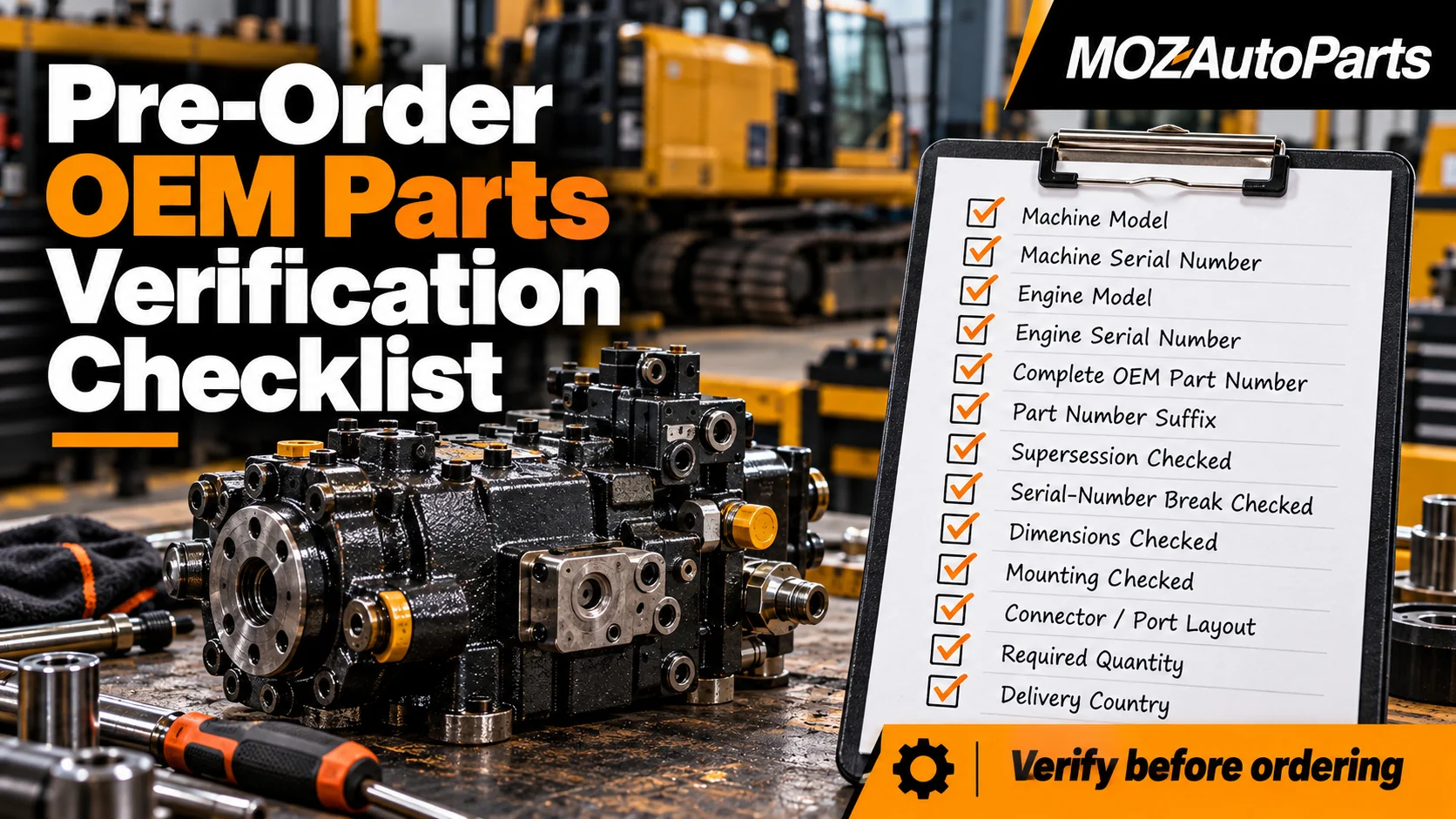
Before placing your order, check the applicable items below. Five minutes is an initial review, not a guarantee that a complex fitment can be confirmed that quickly.
- ☐ Equipment manufacturer
- ☐ Machine model
- ☐ Machine serial number / PIN
- ☐ Production year if known
- ☐ Engine manufacturer
- ☐ Engine model
- ☐ Engine serial number
- ☐ Engine arrangement / CPL where applicable
- ☐ Complete OEM part number
- ☐ Part-number suffix
- ☐ Revision code
- ☐ Old component manufacturer
- ☐ Old component model
- ☐ Supersession checked
- ☐ Cross reference checked
- ☐ Serial-number break checked
- ☐ Dimensions compared
- ☐ Mounting configuration checked
- ☐ Connector or port layout checked
- ☐ Voltage / amperage checked
- ☐ Pressure / flow checked where applicable
- ☐ Left/right/front/rear position confirmed
- ☐ Photo of machine data plate available
- ☐ Photo of engine data plate available
- ☐ Clear photos of the old component available
If a critical item is missing or conflicting, request fitment verification before ordering. Keep the catalog reference, supplier confirmation, agreed part number, kit contents, and quotation together for receiving inspection.
What If the OEM Part Number Is Unreadable?
A damaged label does not necessarily prevent identification. Work through these steps:
- Record the machine make, model, and serial number/PIN from its plate.
- For engine components, record the engine model, serial number, and arrangement/CPL if shown.
- Photograph the full component, mounting, ports, connectors, shaft, and any markings.
- Transcribe partial numbers exactly; mark uncertain characters rather than guessing.
- Locate the component in the serial-specific OEM parts diagram.
- Ask a parts specialist to reconcile the catalog result with the installed component.
A casting or supplier number can narrow the search without being sufficient to place an order.
How MOZAutoParts Can Help Verify a Replacement Part
Send the full number exactly as marked, together with the machine make/model, serial number, engine identification, quantity, and delivery country. Include component and data-plate photos via the email listed on our contact page.
MOZAutoParts can use this information to help cross-check the requested replacement before quotation. Ask the quotation to specify the supplied brand, condition, part number, and included accessories, especially for high-value assemblies.
Frequently Asked Questions
How do I verify an OEM part number?
Start with the number on the original component, then compare it with the exact machine model, machine serial number, engine information, and OEM parts catalog. Check for serial-number breaks and superseded numbers before ordering.
Is the number on the old part always the OEM part number?
No. A component can carry a serial number, casting number, manufacturer number, assembly number, revision code, or date code in addition to the actual service part number.
Can I find the correct part using only the machine model?
Sometimes, but it is risky for many heavy-equipment components. Machines with the same model name can use different parts depending on serial number, production period, engine configuration, or revision.
What is a serial number break?
A serial number break is a production boundary where the manufacturer changed a component or configuration. Parts used before and after the break may have different numbers.
What does superseded part number mean?
A superseded part number is an older service number that has been replaced by a newer number. The newer part may include a design or supplier update.
Can I still use the old superseded part number?
It depends. Supersession is generally directional. A newer service part may replace the older version, but an older part is not automatically suitable for an application designed for the newer version.
What is the difference between a cross-reference and a supersession?
Supersession is typically a manufacturer-controlled replacement relationship between old and new service numbers. Cross-reference indicates that another part may be equivalent or compatible, but additional technical verification may still be required.
Is a casting number enough to identify a replacement part?
Usually not. A casting number can identify a housing or unfinished casting rather than the complete service component. Provide machine details and photos for further identification.
Do I need the engine serial number?
For engine-related parts, yes whenever possible. Injectors, pumps, turbos, starters, sensors, and other components may vary between engine configurations.
What information should I send if I cannot find the part number?
Send the machine make, model, serial number, engine details, photos of the machine data plate, engine data plate, and old component from several angles.
Need Help Confirming an OEM Part Number?
Request a parts quote with the full part number + machine model + serial number + quantity + delivery country.
If the number is missing or uncertain, contact MOZAutoParts and email photos of the old component and identification plates so the team can help review replacement options.