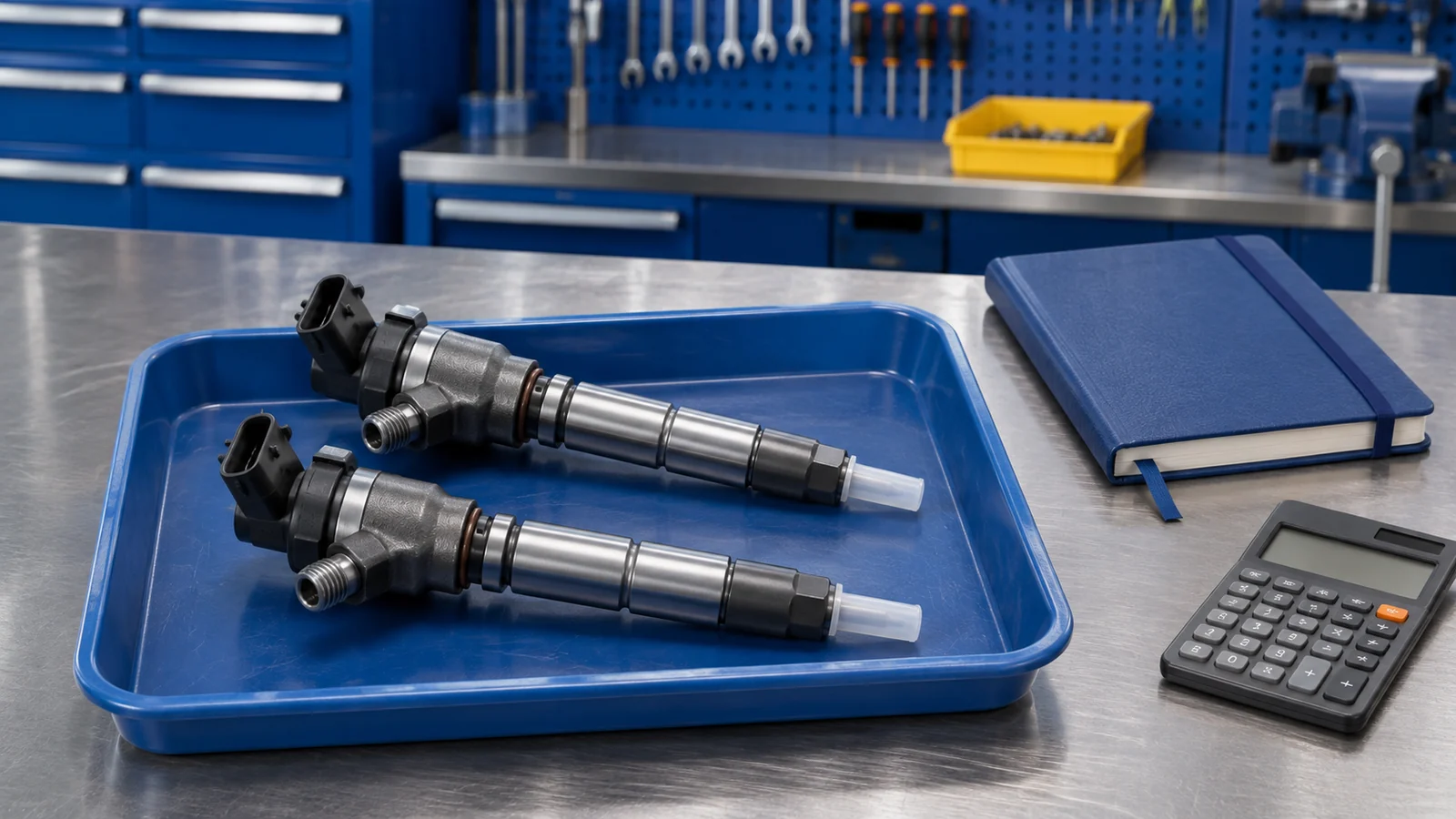
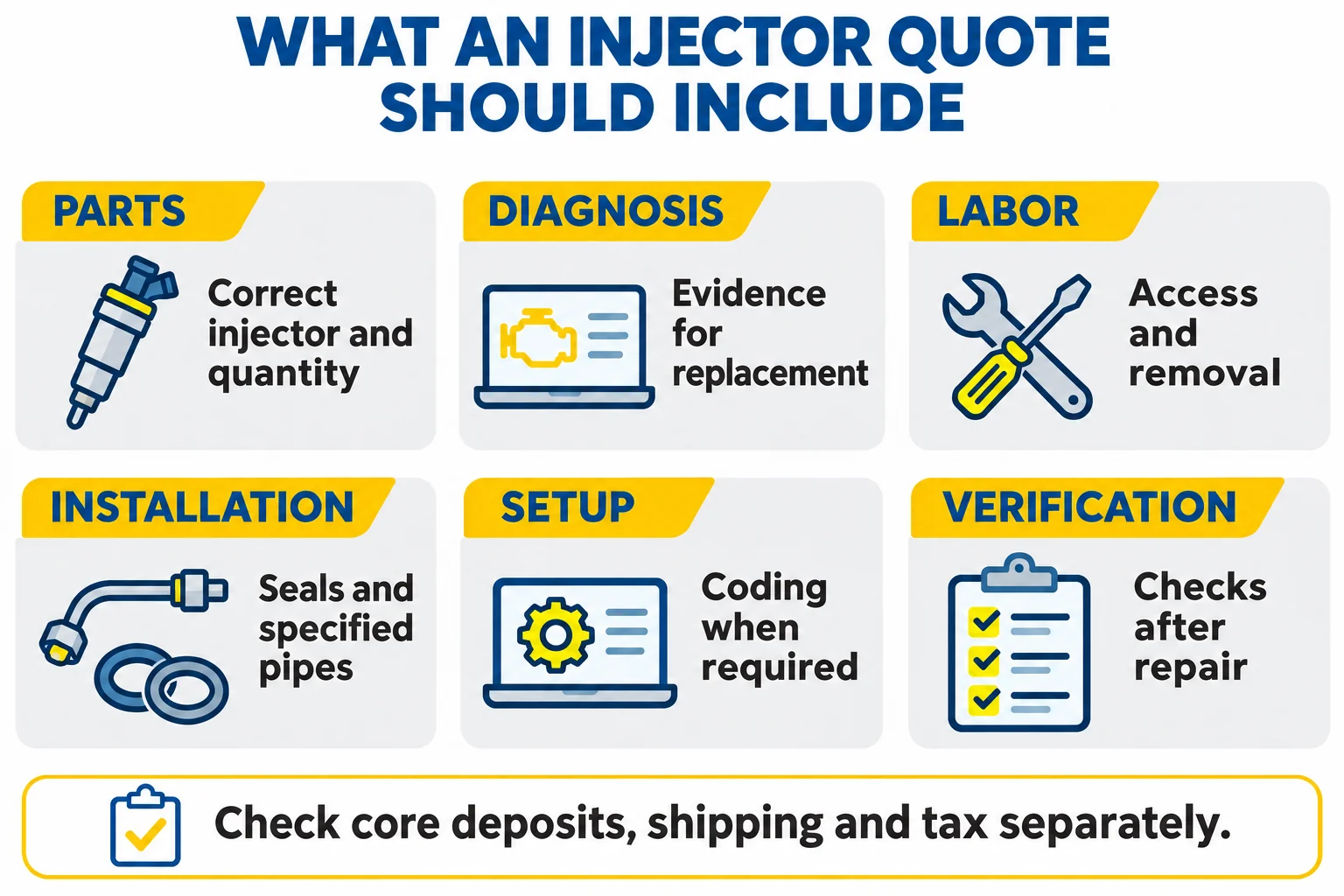
Diesel fuel injector replacement cost depends on the exact injector, the number that actually need replacement, access to the engine, and the work required to restore correct operation. A useful quote separates diagnosis, injectors, seals and specified pipes, installation labor, coding when required, and checks after repair. A low price for one injector is not a complete repair estimate.
Before authorizing replacement, ask what evidence identifies the failed component. Hard starting, uneven idle, smoke, and loss of power can also involve restricted fuel supply, electrical faults, compression problems, or incorrect control signals. This guide explains how to assess the diagnosis, compare new and remanufactured injectors, and build a cost comparison for a truck, tractor, excavator, or generator.
What determines diesel fuel injector replacement cost?
Start with the engine identification and the injector part number. Two machines with similar horsepower may use different injection technologies, different cylinder counts, and very different installation procedures. Even the same machine model can have changes across engine serial numbers or emissions configurations.
Traditional mechanical injectors, electronically controlled common-rail injectors, and unit injectors should not be priced as interchangeable components. A common-rail injector receives pressurized fuel from a shared rail. A unit injector combines functions differently and may require additional engine adjustments. Identify the actual system before comparing listings.
The following items should be visible in the quotation:
| Cost item | What to confirm | Why the total can change |
|---|---|---|
| Diagnosis | Tests included and findings supplied | A no-start investigation can require more work than replacing a confirmed faulty part |
| Injector | Exact reference, quantity, and condition | New, exchange, and repaired units have different supply arrangements |
| Installation parts | Seals, washers, clamps, bolts, and pipes as specified | Some parts are single use or have restricted reuse conditions |
| Labor | Access, removal, preparation, and installation | Covers, intake components, or machine bodywork can obstruct access |
| Coding and setup | Required calibration entry and learning procedures | Requirements differ by engine and control system |
| Verification | Leak inspection and relevant operating checks | Completing installation is only one stage of the job |
| Additional charges | Core deposit, shipping, tax, and mobile travel | These may be outside the advertised parts price |
Ask whether the labor allowance assumes that every injector comes out normally. A seized injector or damaged seat can change the job significantly. The workshop should explain how it will seek approval for additional work instead of treating an uncertain extraction as a guaranteed fixed-price operation.
Budget examples: compare the same scope of work
The calculations below use invented USD inputs to show how a quote works. They are not market averages, current supplier prices, or MOZAutoParts offers. Replace every input with prices for your engine and location.
For a hypothetical single-injector repair, assume an injector costs $350, installation parts cost $60, diagnosis costs $120, installation requires two hours at $110 per hour, and coding plus final checks cost $80. The example subtotal is $830 before tax and shipping: $350 + $60 + $120 + $220 + $80.
For a hypothetical four-injector job, assume four injectors at $350 each, installation parts of $180, diagnosis of $120, five hours of installation at $110 per hour, and coding plus verification of $150. The example subtotal is $2,400 before tax and shipping. These two examples do not imply that four injectors should be replaced whenever one fails.
| Assumed charge | One-injector example | Four-injector example |
|---|---|---|
| Injectors | $350 | $1,400 |
| Installation parts | $60 | $180 |
| Diagnosis | $120 | $120 |
| Installation labor | $220 | $550 |
| Coding and verification | $80 | $150 |
| Example subtotal | $830 | $2,400 |
The installation hours in this illustration exclude the separately listed diagnosis and setup. Actual workshops may bundle those tasks. Check the definitions so you do not count the same labor twice. An exchange injector may also require an upfront core deposit that is returned only when the old unit meets the supplier's acceptance rules.
A complete engine set does not necessarily multiply the entire single-injector bill by the cylinder count. Some access work is shared. Equally, the cost of a single injector does not predict the cost of repairing a contaminated fuel system. Compare the complete agreed job rather than multiplying one advertised number.
Which symptoms justify injector testing?
Injector testing becomes relevant when the engine has an unexplained cylinder imbalance, repeated hard starting, irregular idle, abnormal combustion noise, smoke, or a fuel-system fault code. Record when the problem occurs. Cold starting, hot restarting, heavy loading, and a fault appearing immediately after servicing are different diagnostic starting points.
A symptom is a reason to investigate, not proof that an injector is defective. A restricted filter can reduce delivery to the injection system. A poor electrical connection can interrupt an otherwise functional injector. A cylinder with a mechanical problem can also show abnormal contribution data.
For a machine that loses power under load, review the clogged diesel fuel filter symptoms guide before assuming that the injectors need replacing. If the engine stops immediately when the key leaves the start position, the fuel shut-off solenoid guide may be a more relevant starting point on engines equipped with that device.
Give the workshop a short history: operating hours, recent fuel delivery, last filter change, recent repairs, warning messages, and whether the problem started gradually or suddenly. Clear history can reduce unnecessary investigation and makes the eventual quote easier to understand.
A practical injector diagnosis sequence
1. Establish the engine and fault conditions
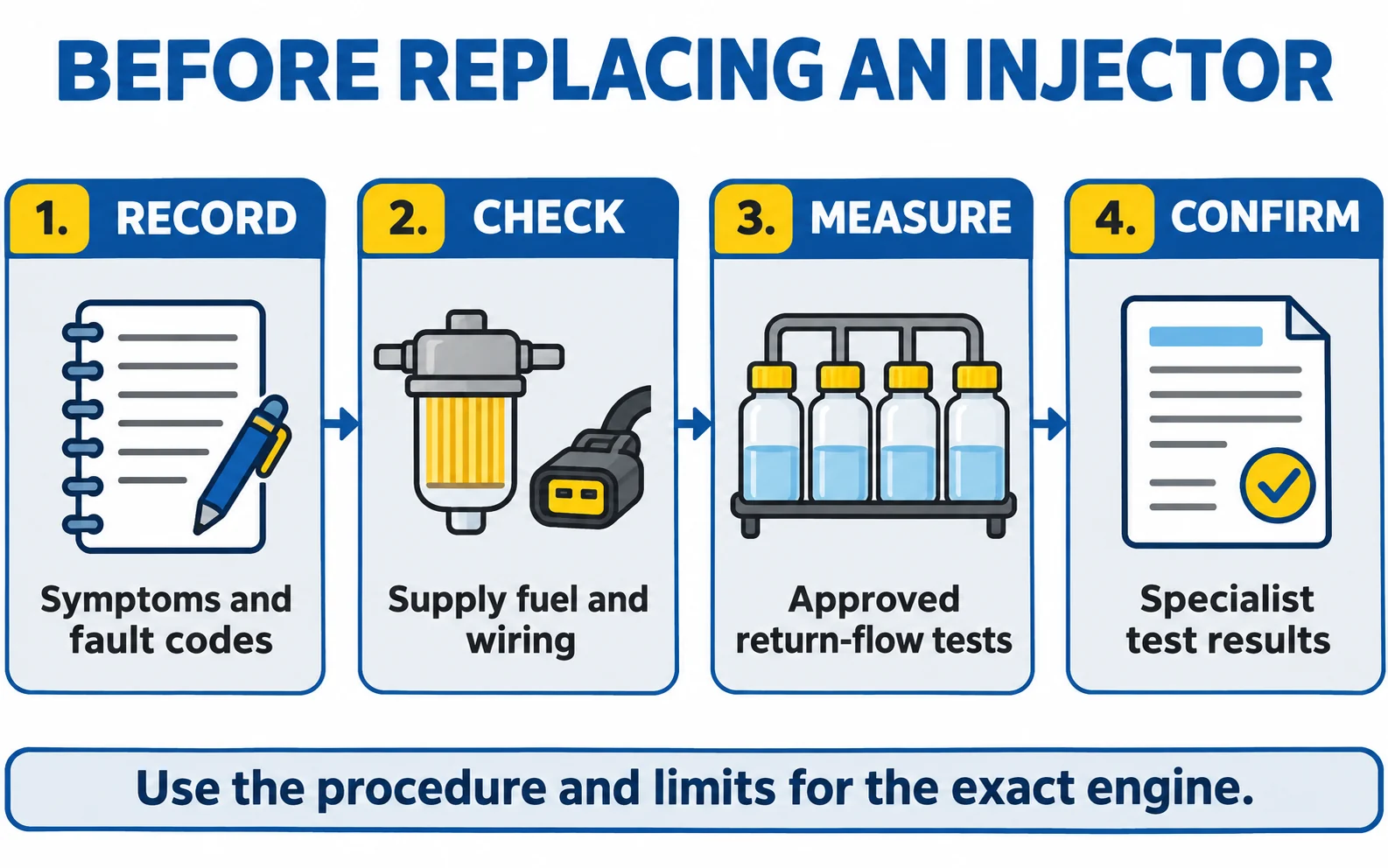
The technician needs the engine model, serial number, and relevant service information. Diagnostic codes should be recorded with available operating data before clearing anything. A code identifies a condition detected by the controller; it does not automatically identify the component to buy.
Ask whether the complaint was reproduced and which basic checks were completed. Where applicable, those checks include cranking performance, fuel supply, connector condition, and the engine's ability to meet the conditions needed for injection. Testing should follow the correct manual rather than a procedure copied from an unrelated engine.
2. Assess injector operation with suitable equipment
Different tests answer different questions. Return-flow or leak-off testing evaluates fuel returning through the injector under specified conditions. Electrical testing evaluates the actuator or circuit. Specialist bench testing can evaluate delivery and operation across an approved test plan. A single measurement cannot answer every one of these questions.
Delphi's common-rail servicing guidance describes combining fault-code investigation, back-leakage measurement, pump checks, and electrical assessment. The useful principle is to connect the replacement decision to measured evidence.
3. Interpret the results in context
Ask for the conditions and limits used to interpret each test. A return quantity without test duration, fuel temperature, or the specified operating state is incomplete evidence. Correction or balance values from a scan tool also require interpretation against the engine's procedure and other possible causes.
An ordinary multimeter continuity check does not establish that an injector meters fuel correctly. Common-rail solenoid and piezo designs have different electrical requirements. Do not apply battery voltage directly to an injector or improvise a test with a generic power supply.
4. Decide what must be repaired
A useful report identifies the failed injector or injectors, the evidence, and any contributing system fault. It should distinguish the required repair from optional preventive work. If the workshop proposes replacing the full set, ask why the evidence supports that scope.
Common-rail safety: where owner checks should stop
Common-rail diesel equipment operates at pressures that can force fuel through skin. Do not loosen a high-pressure pipe to check whether fuel is arriving, search for a leak with your fingers, or observe an injector spraying outside approved enclosed equipment. Suspected injection injury requires immediate emergency medical assessment even if the surface wound looks small.
Residual pressure can remain after shutdown. A trained technician should follow the engine manufacturer's pressure-release and verification procedure before opening the system. Use the specified protective equipment, tools, and cleanliness controls. Park and isolate the machine safely before any inspection, especially equipment with automatic starting or remote controls.
These precautions also protect the repair budget. Introducing dirt during an unnecessary line opening can turn a diagnostic visit into a larger fuel-system repair. Photographs of the identification plate and existing part are often more useful for an initial quotation than dismantling the system yourself.
Replace one injector or the whole set?
There is no universal rule that one failed injector requires a complete set. The answer depends on the failure mode, test results for the remaining injectors, engine requirements, and the condition of the fuel system.
An isolated electrical failure and evidence of widespread contamination are different situations. If metal or water contamination is suspected, replacing the visibly affected injector alone may leave the cause unresolved. The workshop should determine which components require inspection, cleaning, or replacement under the applicable procedure.
Consider downtime as well as parts cost. For a working machine, a second site visit can be expensive. That may justify testing the other injectors while access is available, but it does not justify calling untested components defective. Ask for a required repair option and, if relevant, a separately priced preventive option.
Keep the findings with the maintenance record. If another problem appears later, records of the original symptoms, test results, and cylinder positions will be more useful than a receipt that only says “injectors replaced.”
New, remanufactured, or rebuilt injectors?
A new injector, an exchange remanufactured injector, and a locally repaired injector are different buying propositions. Compare part identity, testing, traceability, warranty terms, and any core conditions. The words “tested” or “rebuilt” alone do not describe the process or the acceptance standard.
Bosch's diesel repair information describes specialist repair and identification arrangements for supported components. For a proposed repaired unit, ask who performed the work and what documentation connects that unit to its test results.
Repairability depends on the specific injector and fault. Do not assume every common-rail injector can be rebuilt, or that cleaning will repair electrical damage and worn precision surfaces. Confirm whether the offered product is supported for the exact application and whether any required calibration code is supplied.
Check warranty exclusions before purchase. Terms may address contamination, installation, coding, return of the old core, and responsibility for labor. A lower parts price can be poor value if the quote omits essential installation items or leaves the machine waiting for missing documentation.
Installation, coding, and the final handover
The replacement procedure must address extraction, the injector seat, seals, fastening, pipe requirements, and cleanliness. DENSO's injector replacement guidance emphasizes suitable extraction methods, bore condition, correct torque, clean working practices, and application-specific diagnostic procedures after installation.
Some systems require the injector correction code to be entered for the correct cylinder. Coding compensates for the characteristics represented by that injector's code; it is not a repair for the wrong part or a mechanical defect. Other engines use different adjustment or learning procedures. The workshop should confirm the requirement for your engine.
At collection, ask what was verified after repair. Useful handover information includes the parts fitted, cylinder positions, coding or adjustments completed, relevant leak and running checks, and any remaining recommended work. Discuss the original operating condition so the final checks address the actual complaint.
Frequently asked questions
Can I order injectors using only the machine model?
The machine model is a starting point. Supply the engine identification, serial number, and existing injector reference as well. Production changes and engine replacements can make a model-only match unreliable.
Can a fuel additive avoid replacement?
An additive is not a reliable remedy for an electrical fault, damaged precision components, or serious contamination. Use only products approved for the engine and fuel system, and investigate the fault before spending money on repeated treatments.
Does a low rail-pressure code mean the injectors are bad?
No. Supply restrictions, pump control, leakage, sensing, and other faults can affect rail pressure. See the diesel fuel pump testing guide for the distinction between low-pressure supply checks and high-pressure diagnosis.
Why can a quote increase after disassembly?
Access problems, seized components, damaged seats, or previously hidden contamination may change the work required. Agree on the initial scope and the approval process for additional work before the machine is dismantled.
Request a quote with the diagnosis and part identity
Browse injectors and nozzles and related engine spare parts, then request a fitment quote with the OEM part number, machine model, engine model, and serial numbers. Include the quantity, injector position if relevant, test findings, and delivery destination. That information makes a diesel fuel injector replacement cost comparison specific enough to support an informed purchase.