How much does diesel fuel filter replacement cost?
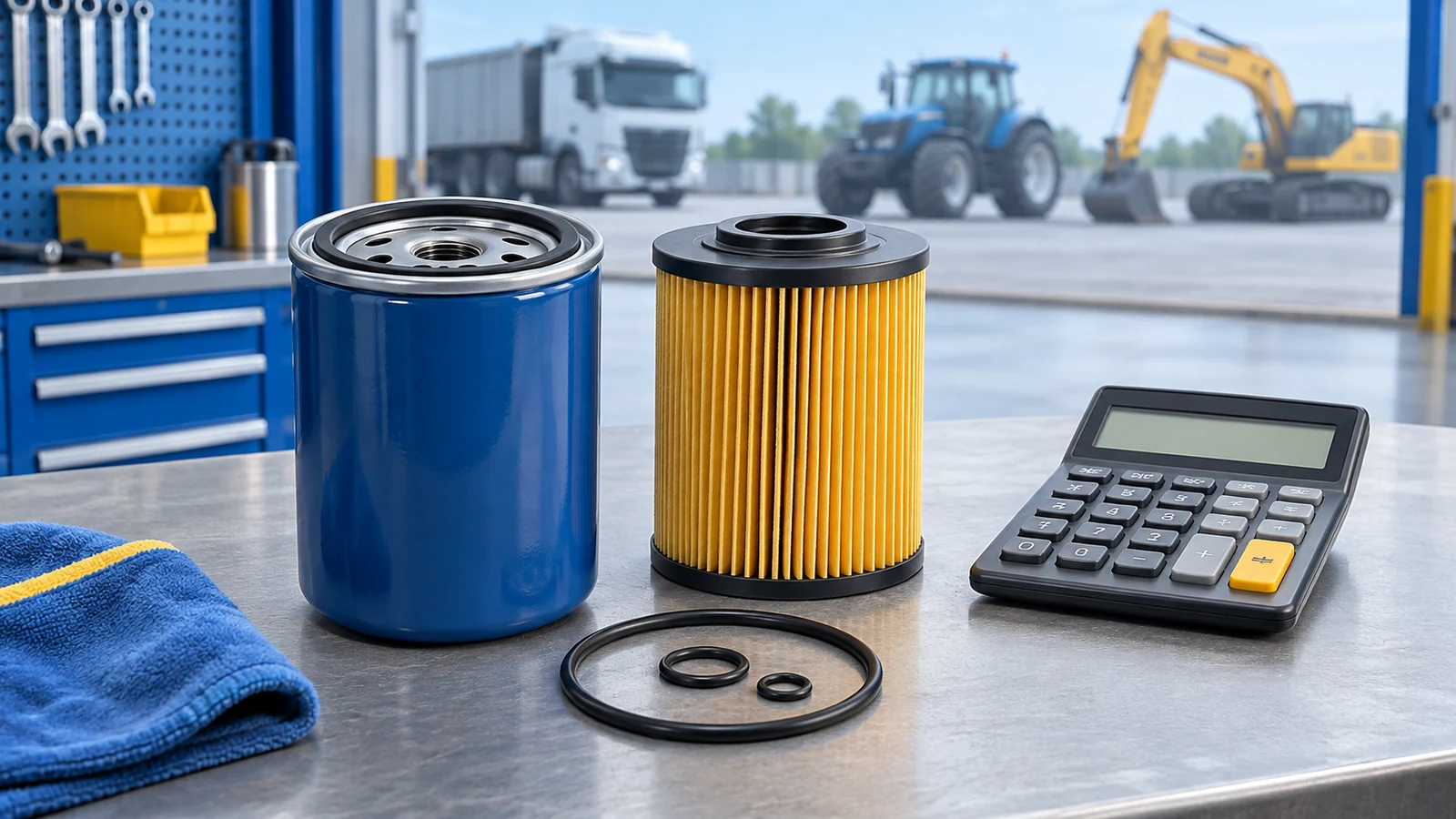
Diesel fuel filter replacement cost depends on the exact filter set, access, labor rate, priming procedure, and whether the job is scheduled maintenance or fault diagnosis. Compare itemized quotes, not a single advertised filter price. A truck, tractor, or excavator may need more than one element, and mobile service can add travel or call-out charges.
There is no verified universal price that covers these three equipment groups. The worked examples below show assumed USD budgets, not market averages, live quotations, or MOZAutoParts selling prices. Replace every assumption with the parts and labor figures for your machine before approving work.
A useful estimate separates the filter from the service surrounding it. Otherwise, a low headline price may exclude seals, the second element, priming, testing, or the cost of reaching a machine that cannot travel to a workshop.
What belongs in a complete replacement quote?
For ordinary scheduled service, use this structure:
Service total = filter elements + required seals or consumables + labor + applicable service fees + tax.
If diagnosis or contamination cleanup is needed, list those separately. Freight, mobile travel, and disposal charges should be stated explicitly rather than hidden in a vague “miscellaneous” line. Some shops include minor consumables in labor; others list them separately. Either approach can be clear if the scope is written down.
Confirm whether the quotation covers:
- Every filter element due for replacement.
- Seals, O-rings, and other required single-use service items.
- Access and removal of guards or covers where necessary.
- Water-separator inspection or draining when applicable.
- The approved priming or bleeding procedure.
- Leak checks, startup checks, and completion of the specified verification.
- Any diagnostic time, travel charge, freight, tax, or disposal fee.
Do not assume a complete assembly and a replacement element are interchangeable quotation items. A housing, bowl, sensor, or primer may be reusable when serviceable, while another job may require one of those components because it is damaged.
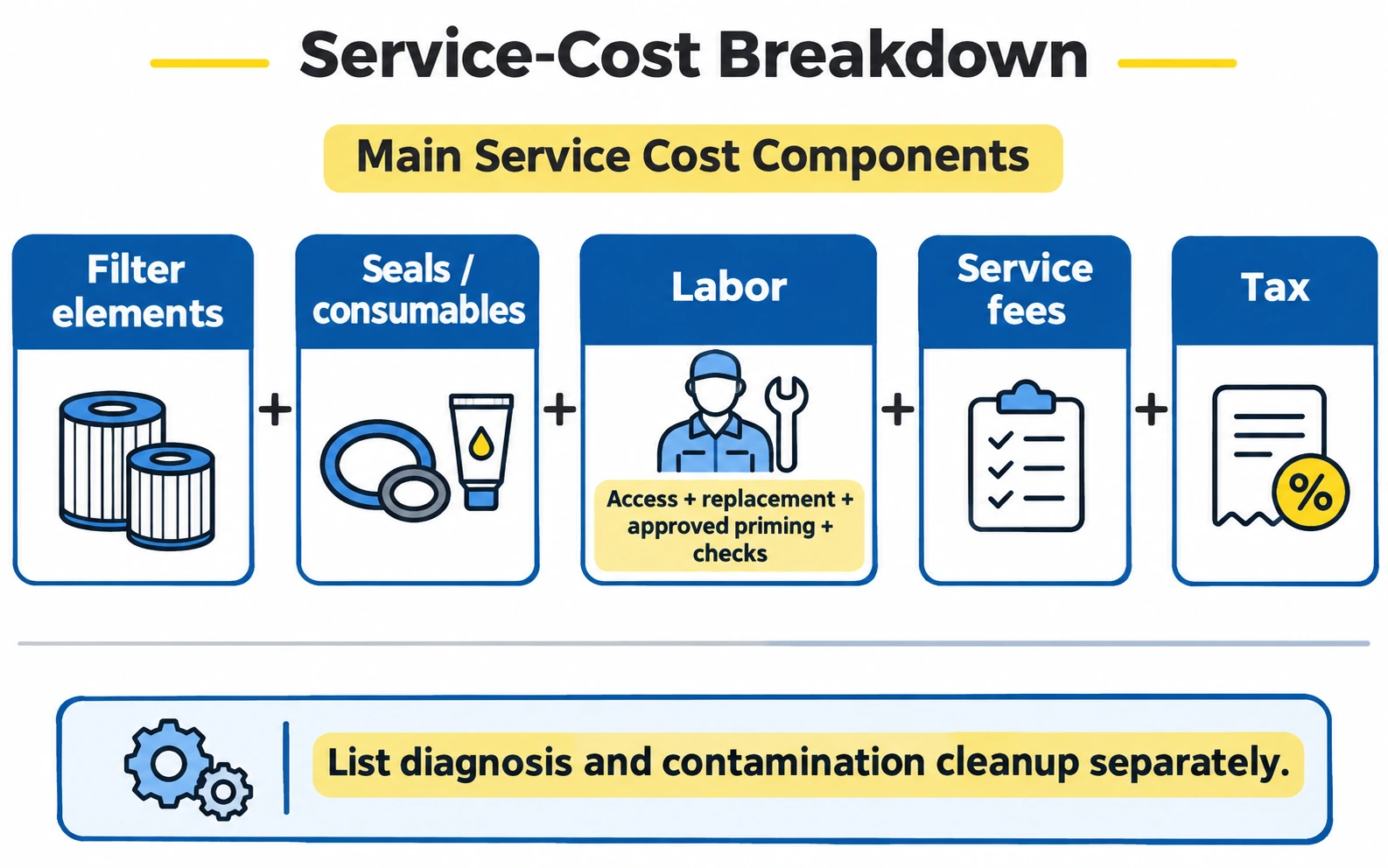
Compare quotes with the same service scope and check that priming is not counted twice.
Example budgets: trucks, tractors, and excavators
The following table is an editorial calculation exercise. All inputs are deliberately stated assumptions in USD. It is not based on a survey of local workshops and should not be described as a typical price range.
| Assumed job | Filter set | Seals and consumables | Assumed labor | Assumed call-out | Calculated subtotal |
|---|---|---|---|---|---|
| Truck, two-element scheduled service in a workshop | $90 | $10 | 1.0 hour at $120/hour = $120 | $0 | $220 |
| Tractor, one-element accessible workshop service | $35 | $10 | 0.75 hour at $100/hour = $75 | $0 | $120 |
| Excavator, two-element service at a jobsite | $100 | $15 | 1.25 hours at $130/hour = $162.50 | $90 | $367.50 |
These subtotals exclude tax, freight, separate diagnostic work, contamination cleanup, and repairs to other components. The assumed labor includes access, replacement, the approved priming process, and post-service checks. It should not be added again as a second priming charge.
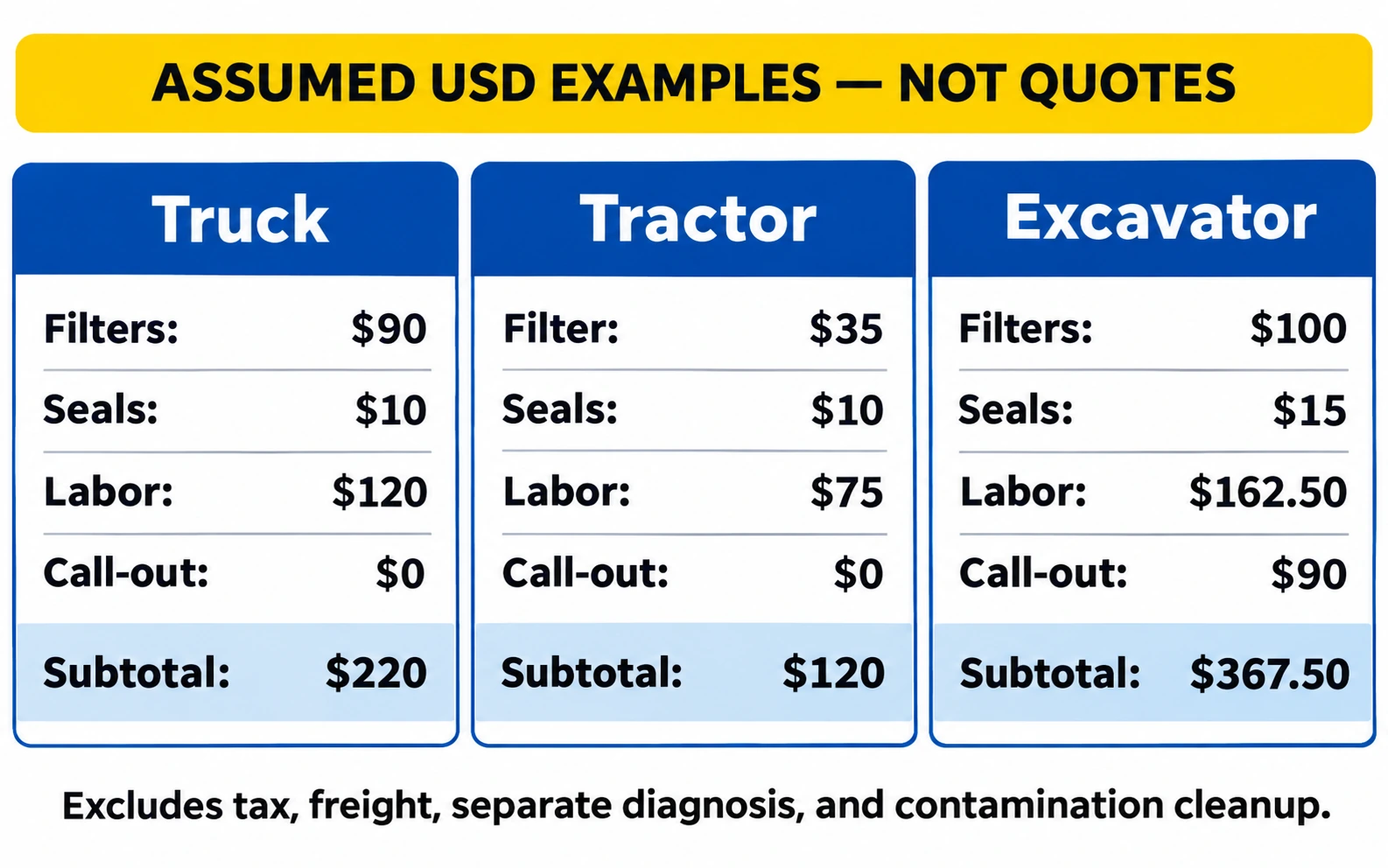
Assumed USD examples, not quotations or market averages. Tax, freight, separate diagnosis, and contamination cleanup are excluded.
The excavator example is more expensive because this scenario includes mobile service, two elements, and more labor. It does not prove that excavators always cost more to service than trucks. A compact excavator in a workshop may be easier to access than a truck with a difficult chassis-mounted filter.
Likewise, the tractor example assumes a straightforward single-element job. A tractor with multiple filters, difficult access, or an unresolved starting fault could have a larger bill. Compare the actual scope before comparing equipment labels.
Why truck fuel filter service costs vary
“Truck” includes pickups, delivery vehicles, and heavy commercial equipment with different engines and filter arrangements. A quote based on the vehicle badge alone may miss the engine variant, production change, or chassis-mounted component.
Ask whether the scheduled service includes a primary water separator, a secondary filter, or a packaged filter kit. Confirm whether a sensor or reusable bowl transfers to the new element and whether fresh seals are included.
Access can dominate the labor difference. The technician may need safe lifting equipment, removal of covers, or time to clean the surrounding area before opening the fuel system. A filter that is inexpensive on a shelf can still be expensive to reach correctly.
The diagnosis is another dividing line. Routine replacement on a running truck is different from investigating a truck that loses power under load or will not restart. If the complaint involves low fuel pressure, ask the shop to separate testing from scheduled maintenance rather than promise that a new filter will necessarily cure it.
Why tractor service costs vary
Tractors range from small utility machines to large agricultural equipment. Some have simple accessible elements, while others use multiple filtration stages and more involved service procedures. Engine identification is essential when ordering the correct kit.
Seasonal operation can change the job. A machine coming out of storage may need fuel-quality checks before replacement makes sense. If water, sediment, or degraded fuel is present, installing a new element without addressing the supply can lead to another interruption.
Location matters during planting, spraying, or harvest. A workshop appointment and a field-service visit are different commercial arrangements. Ask whether travel is included, billed by time, charged per mile, or covered by a fixed call-out.
Keep lost production separate from the mechanic's invoice. Downtime may be a real business cost, but it should not be presented as part of the filter's selling price. Tracking both figures helps determine whether keeping the correct service kit in stock is worthwhile.
Why excavator service costs vary
Excavators often receive fuel from mobile tanks or site dispensing equipment. If filter restriction follows a contaminated delivery, the problem may extend beyond the element. The tank, transfer equipment, and other machines using the same supply may require investigation.
Jobsite access also affects the invoice. A mobile technician may need travel time, site induction, safe access arrangements, and a suitable area for clean work. Guards, accumulated dirt around the housing, and the installation layout can add labor.
An excavator that is immobilized in an awkward position presents a different job from scheduled maintenance on a clean, accessible machine. Before calling out a technician, describe the location, access restrictions, machine condition, and whether attachments can be safely lowered.
Do not assume filter service requires an entire separator assembly. Ask which component is defective and why. Conversely, reusing a cracked bowl, damaged drain, or faulty housing merely to keep the estimate low can cause repeat work.
Filter price is not the same as fitment or performance
A lower purchase price is useful only when the filter meets the application requirements. Confirm the original equipment manufacturer (OEM) part number or a properly supported cross-reference, machine model, serial number, and filter position.
Compare the actual specification and kit contents. Thread size, gasket diameter, flow requirements, filtration performance, water separation, sensor connection, and bowl compatibility can all matter. Matching the appearance or a nominal micron number alone is not sufficient.
An aftermarket element is not automatically unsuitable, and an expensive element is not automatically correct. Ask the supplier to confirm the application and explain any superseded part number. Also check the supplier's warranty and return terms before purchase rather than assuming all parts have identical coverage.
Browse engine spare parts for the relevant system, and use seals, filters and maintenance parts to identify related service items. These category pages are sourcing starting points, not confirmation that a particular part fits your machine.
Priming and verification should be included in the labor scope
Opening a diesel fuel circuit can introduce air. Depending on the engine, the approved process may involve a hand primer, an electric priming function, or another defined procedure. The correct method is installation-specific.
Ask whether the labor quote includes restoring prime, starting the engine, checking for leaks, and verifying operation. This avoids a situation where “filter replacement” means only removing and fitting the element.
Do not assume that filling a new filter with fuel is permitted. Follow the manufacturer's instructions, keeping unfiltered fuel out of clean-side openings. Excessive cranking can create additional problems, so starter duty-cycle limits also matter.
Common-rail fuel lines are not routine bleeding points. Never loosen high-pressure lines as a cost-saving shortcut. High-pressure diesel can cause severe injury, and a trained technician should follow the exact engine procedure.
When comparing estimates, check that priming is not double-counted. A shop can reasonably charge for additional diagnosis when priming fails because of a separate fault, but that work should be explained and authorized.
When the invoice becomes a diagnostic or contamination job
Scheduled maintenance assumes a serviceable system receiving the correct replacement parts. A machine with power loss, stalling, repeated plugging, or a water warning needs a different level of investigation.
Donaldson's fuel filter plugging guidance identifies several possible contamination mechanisms, including fine solids, cold-weather effects, and issues associated with storage and handling. Repeated plugging is not a reliable reason to keep buying the same filter without investigation.
Additional work may involve fuel sampling, tank inspection, water removal, approved cleaning, damaged hose replacement, or testing a supply pump. Do not roll these items into a misleading “fuel filter replacement average.” They have different causes and scopes.
If the shop proposes an injector or high-pressure pump replacement, ask for the diagnostic evidence and a separate estimate. Use the companion guide on clogged diesel fuel filter symptoms to understand why supply-side checks matter before replacing expensive components.
Where unexpected work is possible, agree on an authorization limit. For example, the shop can complete the defined inspection and contact you before expanding the repair. The limit should reflect your budget and the workshop's actual terms, not an arbitrary number from an online article.
DIY versus professional replacement
A competent owner with the exact manual, safe access, correct tools, and an appropriate work area may be able to perform scheduled service on a suitable machine. DIY is not simply the filter's retail price: include seals, consumables, tools, disposal, and your time.
Consider professional service if the machine has an unresolved fuel-pressure fault, difficult access, uncertain priming requirements, recurring water contamination, or unfamiliar high-pressure components. A failed DIY attempt followed by a service call can cost more than a planned workshop visit.
Never treat bypassing the filter, cleaning disposable media, or using an unverified substitute as a saving. These shortcuts can compromise the fuel system. The correct part and procedure are more important than the smallest initial invoice.
A practical decision is to compare two complete scopes: your own scheduled-service cost with the required preparation, and a professional quote with all included checks. Do not compare a bare element price with a fully diagnosed workshop repair.
How to reduce avoidable service costs
Combine fuel filter replacement with other scheduled work only when the maintenance requirements align. Sharing access time may help, but do not delay an overdue fuel service merely to wait for another appointment.
Stock the correct kit if your operating schedule justifies it. Store filters clean, dry, and protected in their packaging, and track part-number changes. A shelf full of visually similar but incorrect filters is not useful inventory.
Improve fuel handling. Donaldson's clean diesel best practices emphasize tank maintenance, monitoring water and contamination, and filtering at appropriate points in the supply chain. Preventing repeated contamination can reduce repeat service visits.
Keep a service log so that parts are changed for a documented reason. Follow diesel fuel filter replacement intervals based on the applicable manual rather than extending the interval to save one filter or replacing it repeatedly without evidence.
Finally, compare like-for-like quotes. The least expensive fully specified job may be good value. The cheapest incomplete quote may become the most expensive once omitted elements, travel, and verification are added.
Questions to ask before approving a quote
Provide the workshop or supplier with the engine and machine identification, current filter numbers, photographs, and whether the request is scheduled maintenance or diagnosis. Then ask:
- Which filter positions and part numbers are included?
- Are required seals and reusable-component inspections included?
- What labor time and hourly rate are being charged?
- Does labor include priming and post-service verification?
- What travel, freight, tax, or disposal charges apply?
- Is diagnosis separate, and what findings would trigger additional work?
- What must be authorized before the estimate can increase?
A written answer makes comparison easier and prevents a complete assembly from being confused with an element-only offer. It also gives the technician enough information to arrive with the correct kit.
Frequently asked questions
Why can two quotes for the same machine be different?
They may include different filter positions, kit contents, labor scopes, or service locations. One may include diagnosis, travel, tax, and verification while another lists only the element. Compare the inclusions before judging the total.
Is excavator fuel filter replacement always more expensive?
No. Machine category alone does not determine the bill. Access, filter count, labor rate, mobile travel, and the condition of the system are more useful comparison factors.
Does replacing both filters double the labor charge?
Not necessarily. Some access and verification steps are shared, while each element still requires its own service procedure. Ask for the combined job time rather than assuming labor is proportional to the number of filters.
Can a cheaper aftermarket filter reduce the cost?
It can reduce the parts portion if it is correctly specified and suitable for the application. Confirm compatibility, performance requirements, seals, and kit contents. Do not rely on appearance or price as evidence of suitability.
Are the example totals actual MOZAutoParts prices?
No. The $120, $220, and $367.50 subtotals are transparent calculations using assumed inputs. They are not quotations, market averages, or price promises. Obtain current parts and service prices for your location and machine.
Request a quote with the complete machine details
The best diesel fuel filter replacement cost comparison begins with a defined job. Separate parts, labor, priming, travel, and diagnosis, then compare estimates that cover the same work.
Request a filter quote with the OEM part number, machine model, and serial number. Include the engine identification, filter position, required quantity, and delivery destination. Ask a local workshop separately for installation labor if that service is not included in the parts quotation.