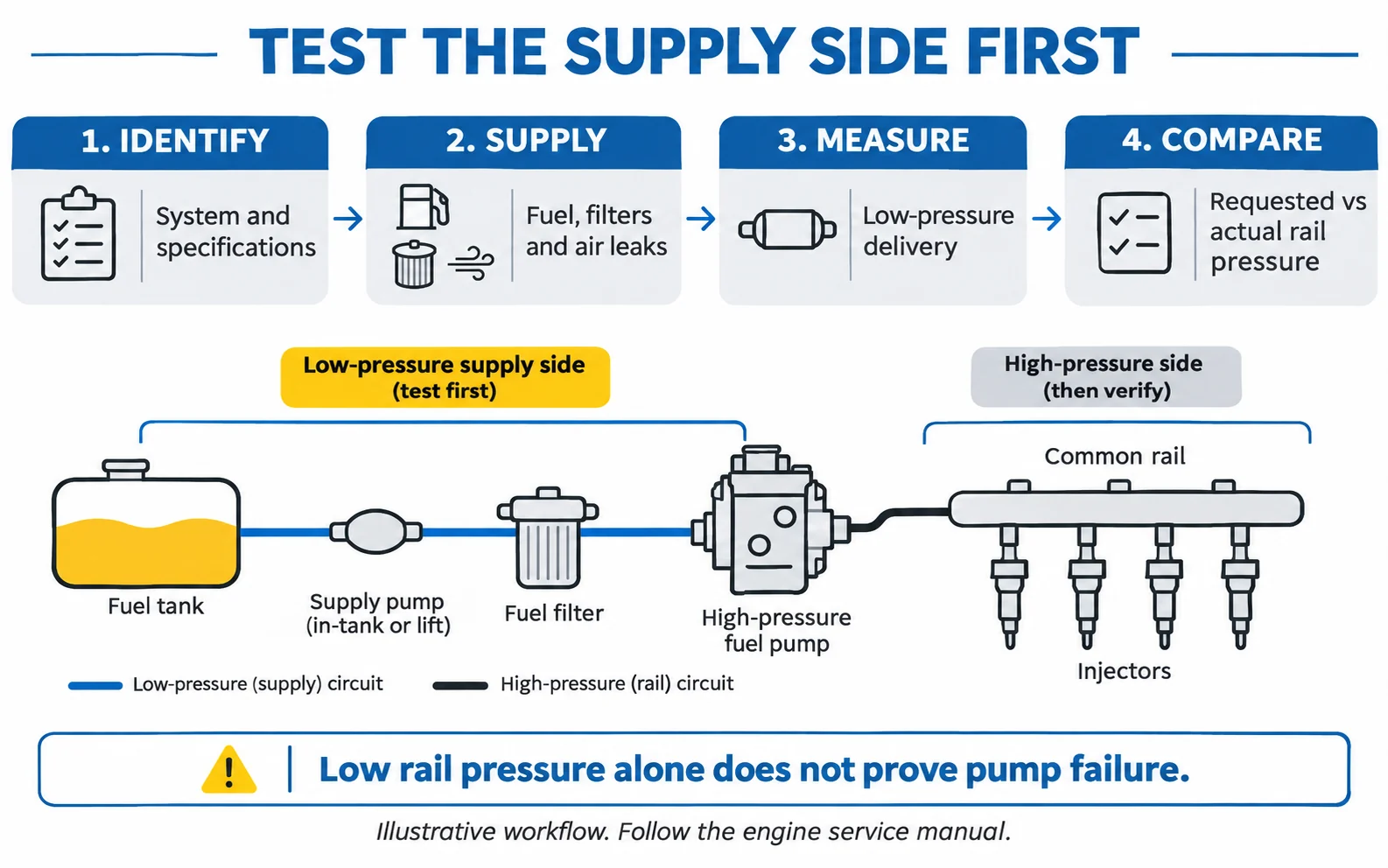
To test a diesel fuel pump correctly, identify the fuel system, check the low-pressure supply first, and compare measurements with the specifications for the exact engine and operating condition. On a common-rail engine, requested and actual rail pressure are useful diagnostic data, but a low reading alone does not prove that the high-pressure pump has failed.
Electric lift pumps, mechanical feed pumps, conventional injection pumps, and common-rail pumps require different checks. An audible pump, a fuel-pressure code, or an engine that briefly starts is not a complete diagnosis. This guide explains what each test can establish, what to record, and when specialist equipment is needed before ordering a replacement.
Identify which diesel fuel pump you are testing
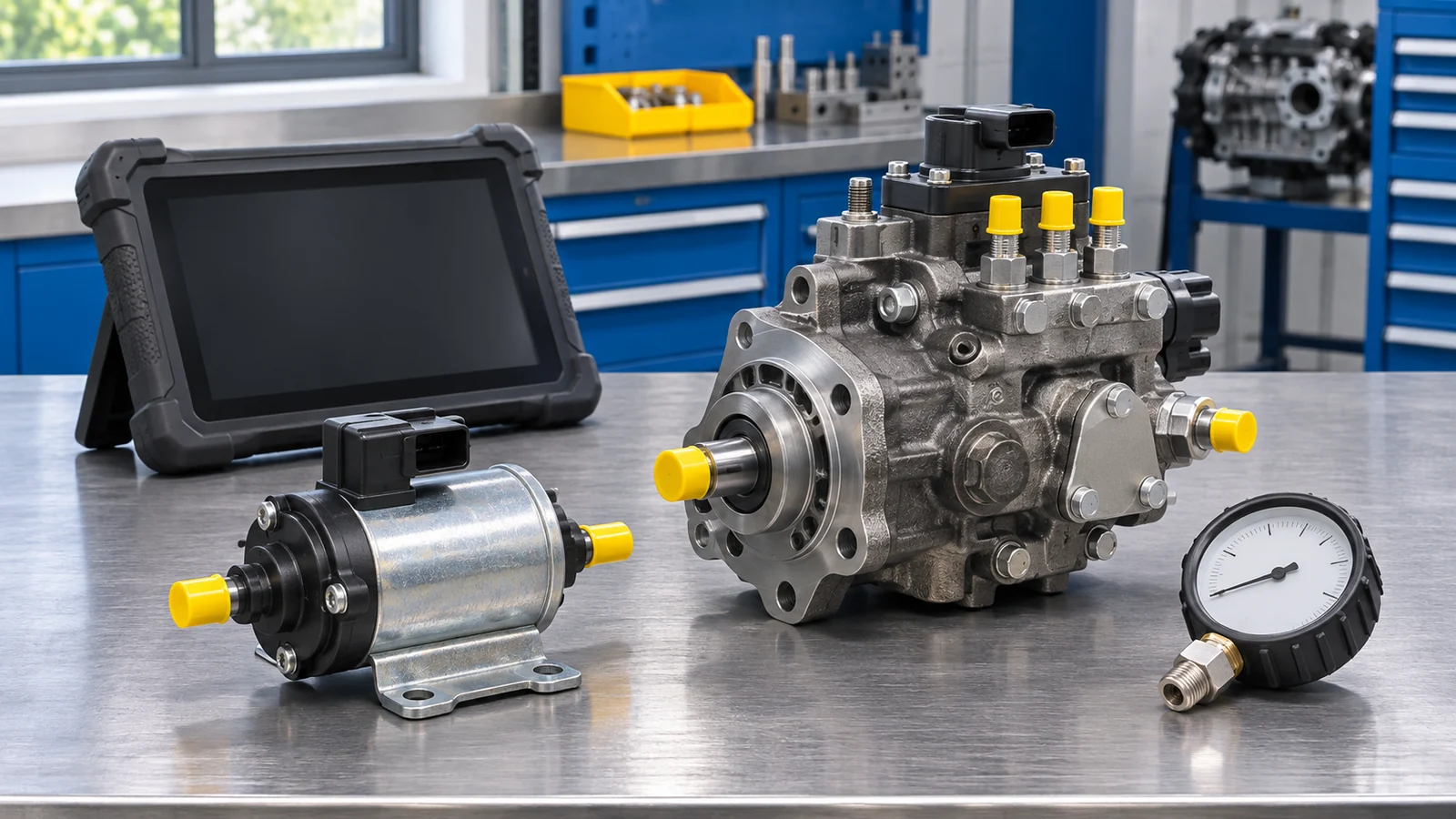
The low-pressure side delivers fuel from the tank toward the injection equipment. Depending on the engine, it may use an electric lift pump, a mechanically driven feed pump, or a supply stage integrated into another assembly. Some sections operate under suction, so an air leak may admit air without showing a conspicuous external diesel leak.
The high-pressure side prepares fuel for injection. In a common-rail system, a pump supplies a shared pressure reservoir, and the control system regulates delivery to the injectors. Conventional inline or rotary injection systems work differently. A common-rail diagnostic routine is not automatically suitable for a mechanically governed injection pump.
| Component | Main diagnostic question | Suitable evidence |
|---|---|---|
| Electric supply pump | Is the pump being commanded and receiving usable electrical power? | Circuit checks plus specified pressure and delivery measurements |
| Mechanical feed pump | Is the inlet supplied and the pump driven correctly? | Inlet condition, drive inspection, and specified delivery tests |
| Common-rail high-pressure pump | Can the system achieve the commanded pressure under the required conditions? | Scan data followed by approved isolation or specialist tests |
| Conventional injection pump | Is the correct quantity delivered at the required timing and control setting? | Engine-specific checks and diesel-specialist testing |
Find the engine model and serial number before selecting a test method. Photograph the pump label if it can be reached safely. The machine badge alone may not identify the engine version, especially on equipment that has been repowered or modified during a previous repair.
Get the specifications before connecting a gauge
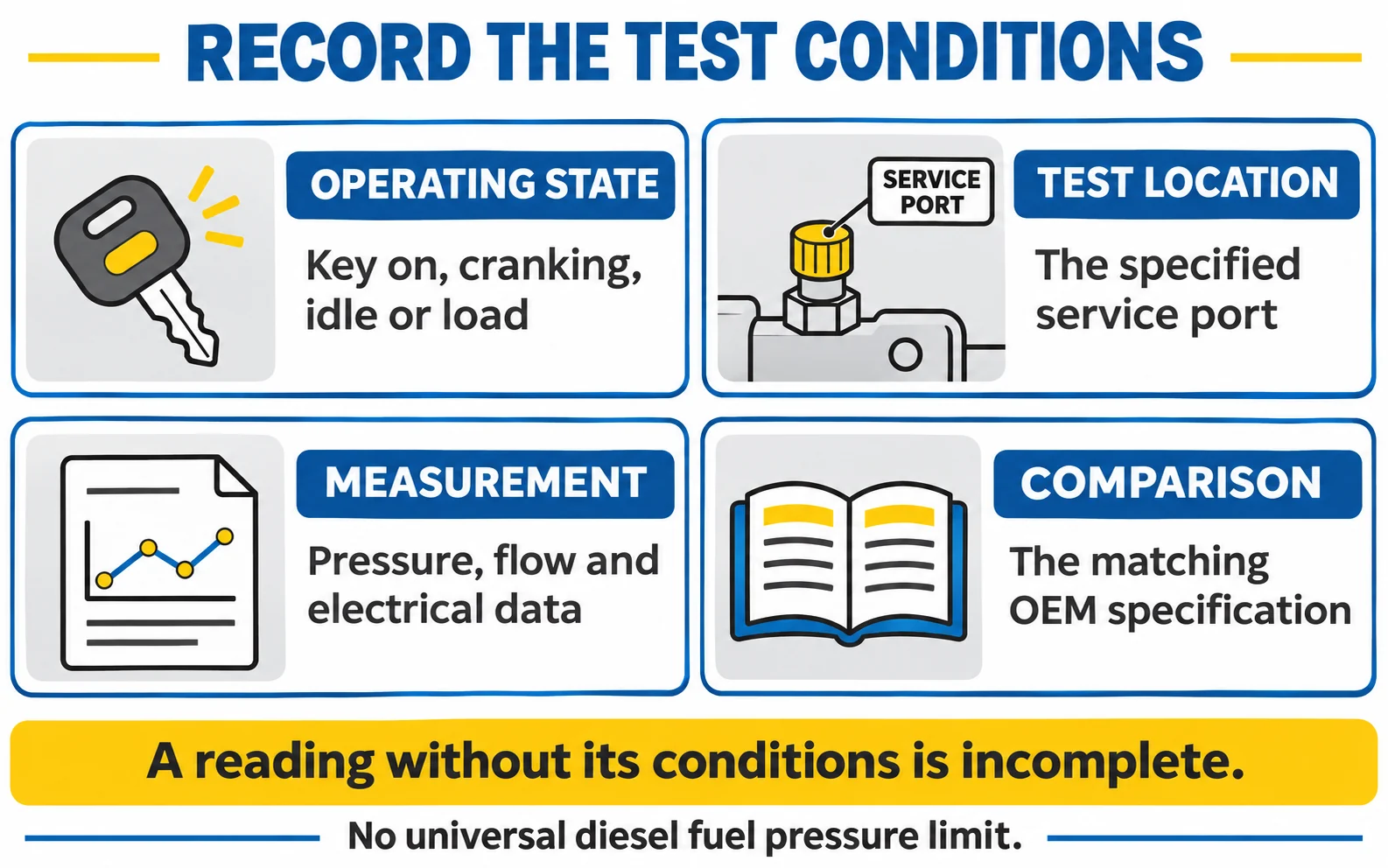
A useful fuel-pressure specification includes more than a number. You need the test location, operating state, permitted range, relevant temperature conditions, and required tools. A pressure measured at a pump outlet may differ from pressure measured downstream of a restrictive component.
Write down whether the manual calls for key-on priming, cranking, idle, a specified engine speed, or an approved loaded condition. Do not compare an idle reading with a loaded requirement. Some electric pumps run only for a limited priming period or only when the controller receives the required signals.
Pressure units also matter. One bar equals 100 kilopascals, while a megapascal equals ten bar. A screenshot with the unit cropped away is difficult to interpret and can lead to a large conversion error. Keep the unit, engine speed, and test point with every recorded result.
If the correct information is unavailable, stop short of declaring the pump good or bad. You can still collect identification details and document the complaint. That preparation is useful without guessing a threshold borrowed from another vehicle.
Safety boundaries for diesel fuel-pressure testing
Common-rail fuel can penetrate skin and cause a serious internal injury. Never loosen a high-pressure line to look for fuel delivery, feel for a leak, or connect an ordinary low-pressure gauge to the rail. A small-looking suspected injection injury needs immediate emergency medical attention.
Shutting down the engine does not automatically establish that pressure has dissipated. Follow the manufacturer's isolation and residual-pressure verification procedure. Connections must be opened only with the specified equipment and precautions by a suitably trained technician.
Low-pressure testing still requires safe fuel handling. Secure the machine, prevent unintended movement or automatic starting, keep ignition sources away, and use approved containers, hoses, and adapters. Keep test leads clear of belts, fans, hot surfaces, and moving linkages. Do not use improvised bottles, open spraying tests, or unrestricted road testing with loose equipment under the hood.
Step 1: define the complaint before testing
Record whether the engine cranks but will not start, starts and then stops, loses power under load, or has a hot-restart problem. Note fuel level, ambient conditions, recent refueling, and recent maintenance. Preserve fault codes and available freeze-frame information before clearing the controller.
The timing of the complaint can guide the investigation. A problem beginning immediately after a filter change makes incorrect assembly, an unsealed connection, or incomplete priming worth checking. A failure that appears only during sustained work may need measurements during the approved loaded test, not just in the workshop at idle.
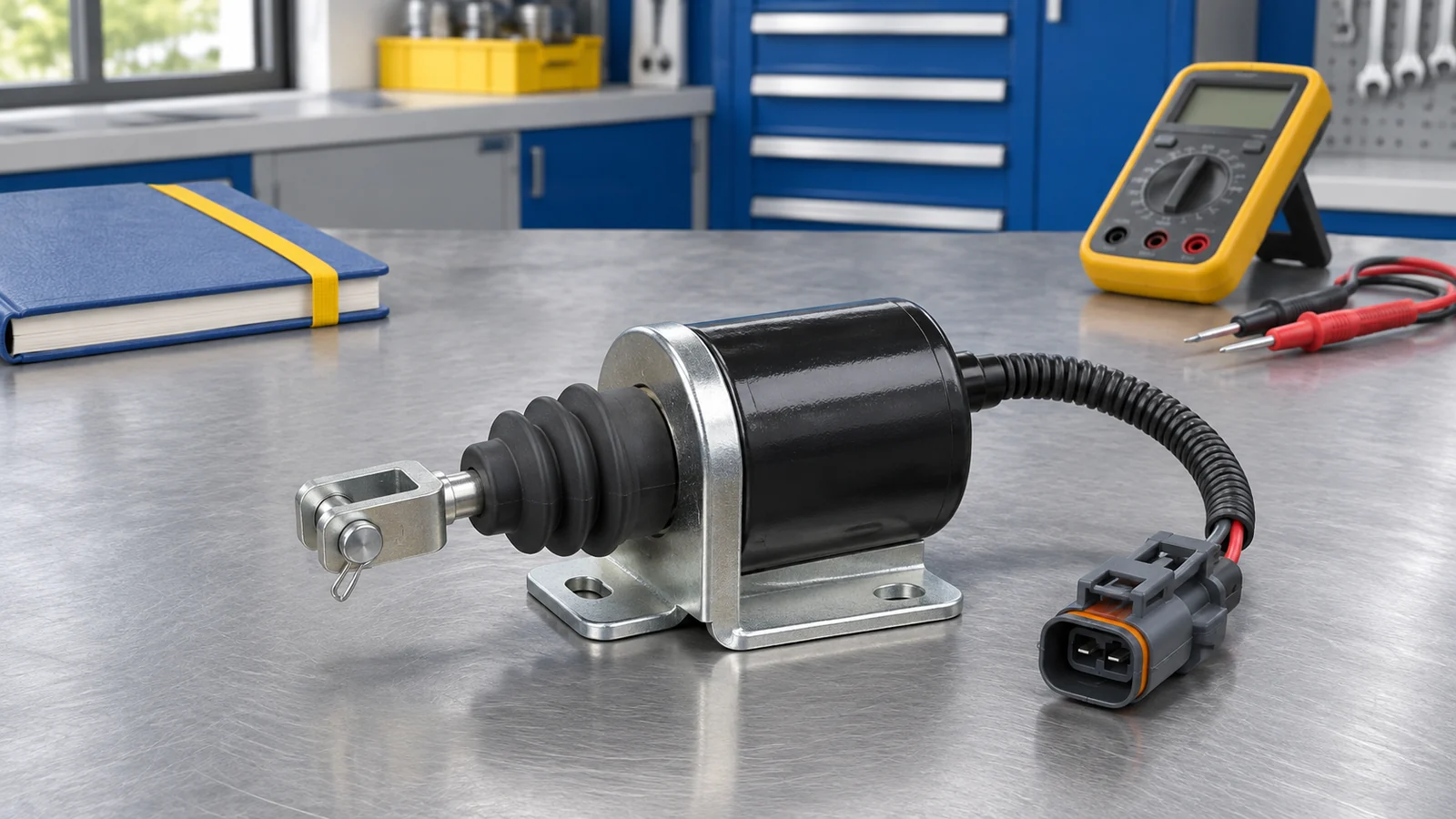
Also establish that the engine can crank as required and that the control system permits starting. The best fuel pump cannot overcome an unrelated start authorization problem. Where a mechanically controlled engine starts only while the key is held in START, investigate the fuel shut-off solenoid and its control circuit as well.
Step 2: inspect the supply path
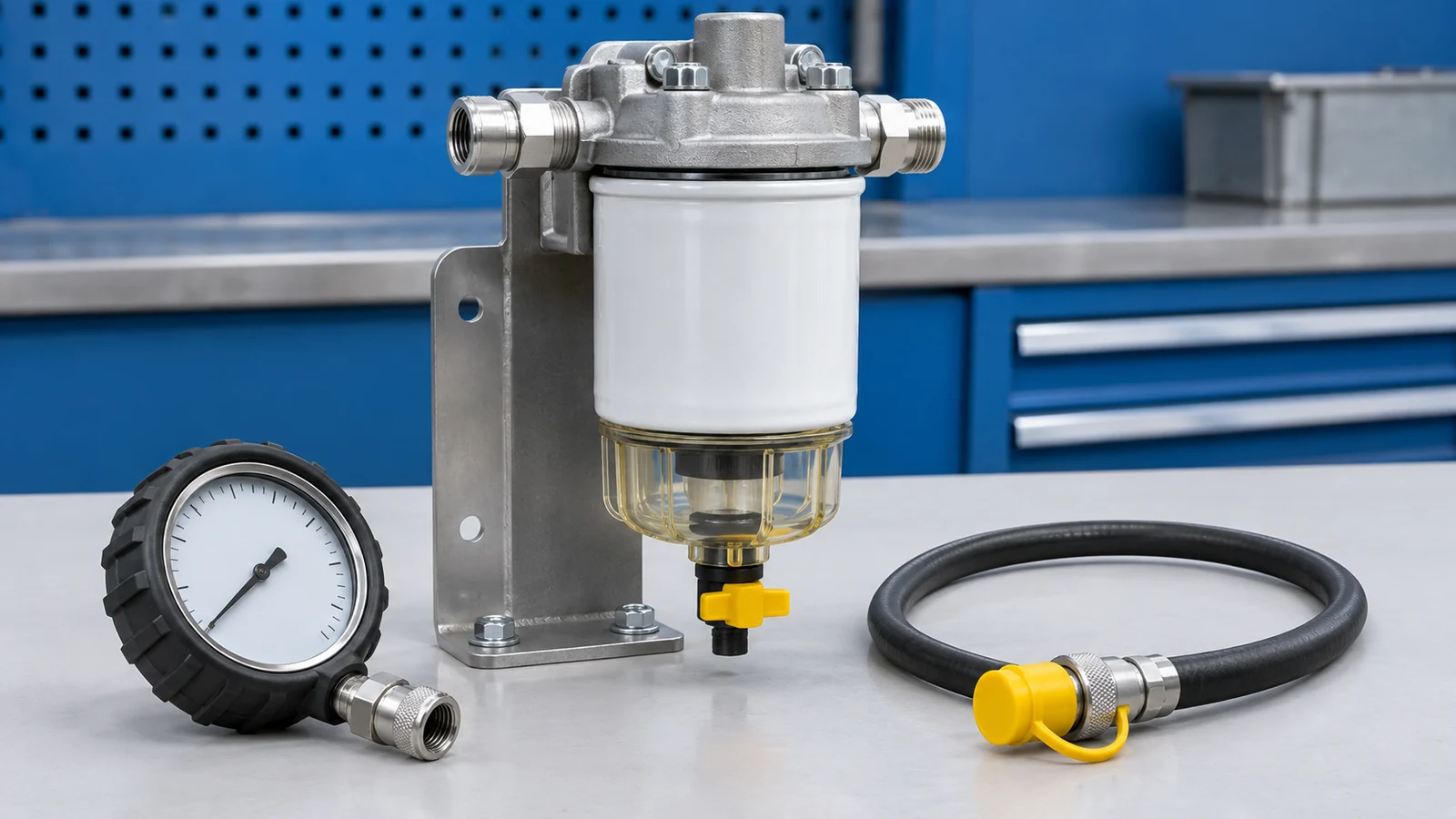
Before condemning a pump, inspect the accessible fuel path for damaged hoses, loose connections, incorrect routing, fuel leakage, and obvious contamination. Check the correct filter reference, service history, and installation. Follow the manual for water-separator inspection and drainage rather than opening components indiscriminately.
The diesel fuel filter diagnosis guide explains why restriction and pump failure can produce overlapping complaints. Replacing the pump without correcting a blocked pickup, restricted filter, or recurring air entry may leave the symptom unchanged.
An approved suction or restriction measurement can help identify an upstream problem. Delphi offers a low-pressure diagnostic tool designed to assess both positive and negative pressure. Its measurement range describes the instrument's capability, not a normal pressure range for every diesel engine.
Avoid bypassing the filter to make the engine run. That can send contamination toward expensive injection components. If dirt, water, or metal debris is found, preserve the evidence and determine the required contamination procedure before fitting new parts.
Step 3: check an electric lift pump under the correct conditions
Confirm when the pump should operate using the wiring diagram and control strategy. Silence during a key-on check does not prove failure if the controller is not commanding the pump at that moment. Conversely, hearing the pump run does not prove that it delivers enough fuel.
A technician can assess the supply and return electrical paths with the circuit operating as specified. A voltage reading at an unplugged connector may look normal even when a poor connection cannot carry the working current. Loaded voltage-drop checks help distinguish wiring resistance from a defective pump.
Inspect the fuse, relay, connector condition, and ground path according to the diagram. Do not increase a fuse rating to keep the circuit working or bridge control terminals without the approved procedure. A repeated fuse failure needs diagnosis, not a larger fuse.
Current measurements may add information when interpreted against the correct specification and circuit design. Use an appropriate current clamp or approved method. Do not place a multimeter in current mode directly across the battery or pump supply; that creates a short circuit rather than a useful test.
Step 4: measure low-pressure delivery
Pressure, available delivery volume, and electrical condition are related but distinct. A pump may produce a static pressure reading yet fail to maintain delivery under the required demand. Restrictions or poor electrical supply can also alter the result.
Delphi's pressure and flow testing explanation highlights the need to assess pressure, volume, and electrical integrity before replacing a pump. Its illustrated procedure concerns a particular return-type delivery arrangement; the specific hookup and collection routine should not be copied across all diesel systems.
Use the engine's specified test point, approved adapters, and required operating condition. Record the result and compare it with the corresponding service limit. Where the procedure includes a delivery-volume test, use the specified duration and collection equipment, then restore the system and check it as directed.
For a mechanical feed pump, check the inlet and drive arrangement before interpreting poor delivery as internal pump damage. Do not assume that a hand primer and an engine-driven pump are being tested in the same way. Their operating conditions and functions can differ.
Step 5: compare requested and actual rail pressure
On a suitable common-rail engine, a compatible diagnostic tool can display the pressure requested by the controller and the pressure reported by the sensor. Compare the two during the specified condition, with engine speed and other relevant data recorded alongside them.
A difference is a clue that needs explanation. Possibilities include inadequate supply fuel, excessive leakage, a control or metering problem, incorrect sensor information, or a pump that cannot produce the required output. The code description alone does not select between these possibilities.
Consider what the controller is requesting. If the engine is not authorized to inject or is missing a required synchronization signal, a pressure trace must be interpreted in that context. Repeated cranking without a diagnostic plan can discharge the battery and overheat components while adding little useful information.
Step 6: use specialist tests to isolate the cause
When basic supply checks are satisfactory but rail pressure remains incorrect, the next step is the applicable guided diagnosis. It may involve approved injector return-flow measurement, electrical assessment of controls, or specialized pressure testing.
Delphi's sealed rail diagnostic equipment combines pump-pressure assessment with injector back-leakage measurement. This illustrates why pump and injector behavior may need to be evaluated together. These are equipment-specific procedures for trained users, not instructions to cap arbitrary outlets or unplug actuators to force maximum pressure.
A professional report should say which competing causes were checked and what result supports the final conclusion. “Low pressure” describes the observation. A justified pump replacement decision identifies why the pump, rather than the surrounding supply, control, or leakage path, is responsible.
How to interpret common findings
| Finding | Useful next question | What it does not prove |
|---|---|---|
| Pump can be heard | Does measured delivery meet the applicable requirement? | Sound alone does not confirm adequate fuel supply |
| No voltage at the pump | Was the controller commanding it during the measurement? | The pump itself is not necessarily defective |
| Supply pressure falls during work | Are inlet restriction and electrical supply acceptable? | A new high-pressure pump is not automatically the answer |
| Rail pressure is below request | Have supply, leakage, controls, and sensing been assessed? | The pressure code does not identify one failed part |
| Performance changes after filter service | Are the filter, seals, routing, and priming correct? | A coincidental pump failure should not be assumed |
| Metal contamination is present | What system-wide inspection does the manufacturer require? | A pump-only replacement may not complete the repair |
Keep the original measurements and the final checks in the same report. That makes it possible to compare like-for-like conditions after repair. A workshop note saying only “pressure checked” does not provide enough information for a later technician to understand the decision.
What to confirm before buying a replacement pump
Match the OEM reference, engine serial range, mounting, drive arrangement, fuel connections, and any electrical control requirements. Confirm whether the listing covers the complete assembly or one component. Photographs help identify differences, but visual similarity is not a compatibility guarantee.
Ask about installation parts, setup requirements, and contamination-related work. A replacement may require model-specific timing or calibration steps, while another pump may use a different installation approach. Obtain the correct instructions before scheduling the job.
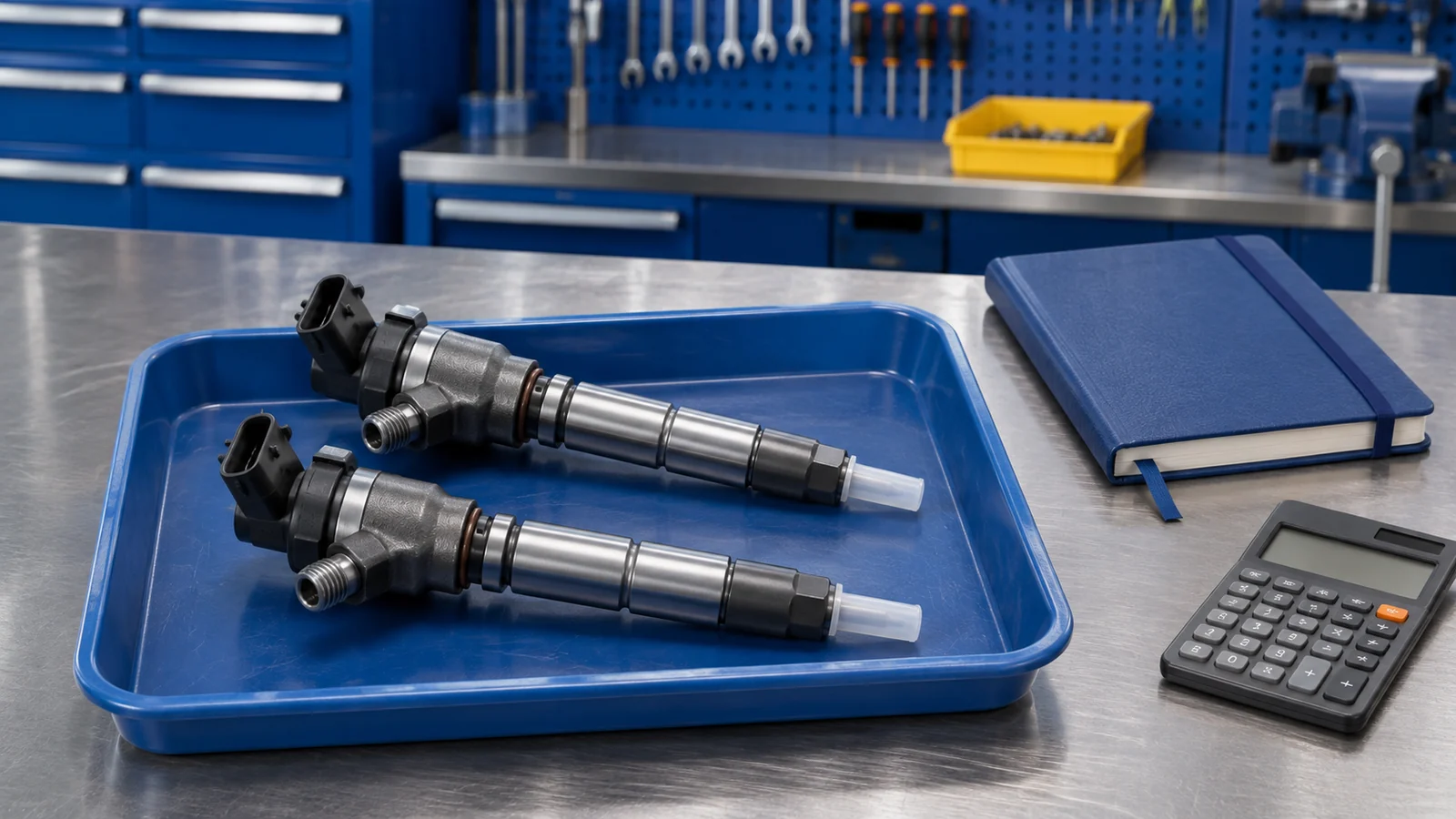
Browse engine spare parts and filters and maintenance parts together when the diagnosis identifies a supply-system problem. For an injector-related pressure loss, consult the injector diagnosis and cost guide before ordering a pump.
Frequently asked questions
Can I test a diesel fuel pump with only a multimeter?
A multimeter can help evaluate an electric pump circuit, but it cannot measure fuel delivery or establish the condition of a common-rail high-pressure pump. The complete procedure may require pressure, flow, scan-data, and specialist measurements.
What pressure should a diesel lift pump produce?
Use the specification for the exact engine, test point, and operating condition. Different supply arrangements have different requirements, and some sections work under suction. A single pressure number is not a safe universal pass-or-fail rule.
Can a clogged filter make a good pump look faulty?
Yes. A restriction can limit supply to the injection system and produce a loss-of-power or low-pressure complaint. Check the filter and upstream path as part of the diagnosis rather than replacing a pump solely from the symptom.
Should I loosen injector pipes to check fuel delivery?
Do not use that method on a common-rail system. High-pressure fuel presents a serious injection hazard. Use the engine's approved diagnostic procedure and suitable equipment.
Is a replacement pump ready to install without other work?
That depends on the application and failure cause. Confirm fitting parts, cleanliness requirements, any timing or setup procedure, and the checks needed after installation. Contamination may require additional work before the replacement is fitted.
Send the test findings with your parts request
Request a pump and fitment quote with the OEM part number, machine model, engine model, serial numbers, and delivery destination. Include the measured test condition and the workshop's conclusion. A clear diagnosis helps identify the correct part and reduces the risk of paying for a replacement that does not solve the original problem.